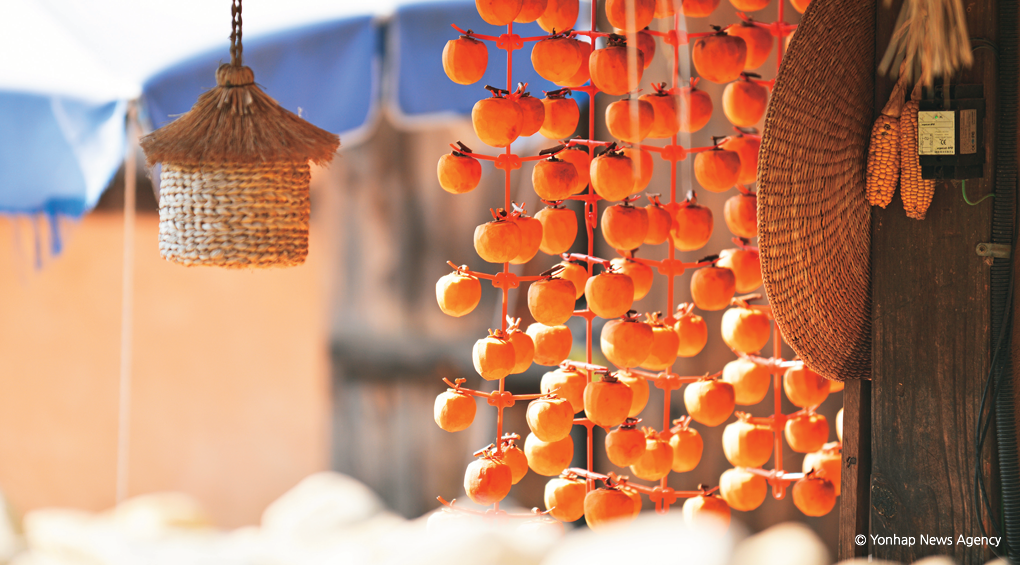
At my childhood home we had many persimmon trees. They blossomed in June, and when their light beige petals fell thick on the ground, we would thread them on s and make necklaces. In autumn, the glossy persimmon leaves were used to wrap tasty rice cakes made with newly harvested grains. But the trees’ greatest gift was, of course, the luscious fruit. Freshly picked, the persimmons’ flesh was soft and sweet, though the best was yet to come.
On a sunny autumn day, all of the adults would sit around on a portable wooden floor in the yard, on which fresh persimmons were piled up in mounds. It was a festive occasion that involved diligent attention — peeling the skin of the persimmons as thinly and neatly as possible.
The peeled fruits were then placed in rows on a large screen that rested on a rack in the yard. When the top part became dry and dark, the persimmons were turned over to dry on the other side. When they had partly dried, just feeling the soft flesh of the fruit was mouthwatering. Too impatient to wait, I used to hover anxiously between the desire to pilfer one or two persimmons from the screen and the fear of being betrayed by the empty spaces that would be left.
When the persimmons were completely dried, they were stored away in earthenware crocks. Sometimes, handfuls would be taken out and stuffed with walnuts or used for drinks such as sujeonggwa, the traditional Korean cinnamon punch. But in general, they were left alone to be eventually placed on the table of ancestral rites or eaten as a late snack on long winter nights.
There is a fun tale that all Koreans hear during childhood. A long, long time ago, on a dark night, a tiger was pacing around the backyard of a house when it heard a mother inside trying to soothe her crying child. “A tiger’s here. You better not cry.” But the child continued to cry. “Look here! It’s a gotgam [dried persimmon]. Now, don’t cry.” The child stopped crying immediately. The tiger, thinking that the dried persimmon must be something more ferocious than itself, became frightened and ran away. Though we no longer have any tigers in our mountains, dried persimmons remain. Thank goodness for that.
 한국국제교류재단