Hanji appeals to both the senses of sight and touch. Its most defining quality, however, only reveals itself over time. Unlike ordinary paper, which weakens as it ages, well-made hanji grows more durable as its fibers stabilize. The epithet “thousand-year paper” is not poetic hyperbole but a testament to a measurable reality: Hanji is a material that endures and even improves under the weight of time.
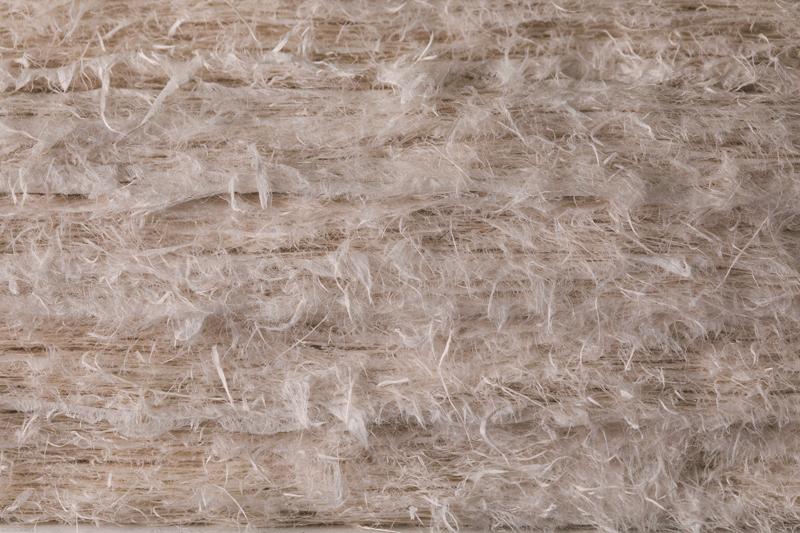
Hanji is produced in workshops across several regions of Korea by families preserving time-honored methods. Regional variations in climate, soil, and local production techniques result in paper with distinct physical properties and uses.
Courtesy of the Korea Craft and Design Foundation
Paper is weak, or so people think. It crumples in a clenched fist, disintegrates upon contact with water, and turns to ash in an instant when lit on fire. Yet, humanity has recorded its history, preserved its art, and safeguarded its memory on this vulnerable medium. Paper may be fragile, but it remains one of the most enduring materials people have ever used. Within the world of paper, however, hanji occupies a unique position. Thanks to its physical qualities, it defies the simple classification of “traditional Korean paper.” At the fingertips, one feels the deep grain, the texture of densely interwoven fibers, the way it gently filters light as if holding it within, and the resilience that allows it to be folded and unfolded without tearing.
Recently, hanji has attracted attention at cultural heritage restoration sites across Europe. For decades, Japanese washi has been regarded as the industry standard in the international conservation paper market. However, as the range of artifacts requiring restoration expands and techniques become more refined, the interaction between the repair paper and the artifact — and especially the paper’s physical properties — is subject to increasingly rigorous scrutiny. In this shifting landscape, Korean handmade paper is emerging not merely as an alternative but as a viable option and a candidate for a new global benchmark. In the inherently conservative field of restoration, hanji is proving its worth.
CRITERIA FOR RESTORATION
In cultural heritage restoration, paper is used as more than just a reinforcement. Conservation paper must support the original artifact without overshadowing it. If the paper is too strong, it risks dominating and damaging the original; if it’s too weak, it fails in its supportive function. The demands are manifold and exacting: tensile strength paired with flexibility, a stable fiber structure, compatibility with adhesives, resistance to acidification, and the capacity for delicate manipulation during the restoration process. The list of requirements is long, with virtually no margin for error.
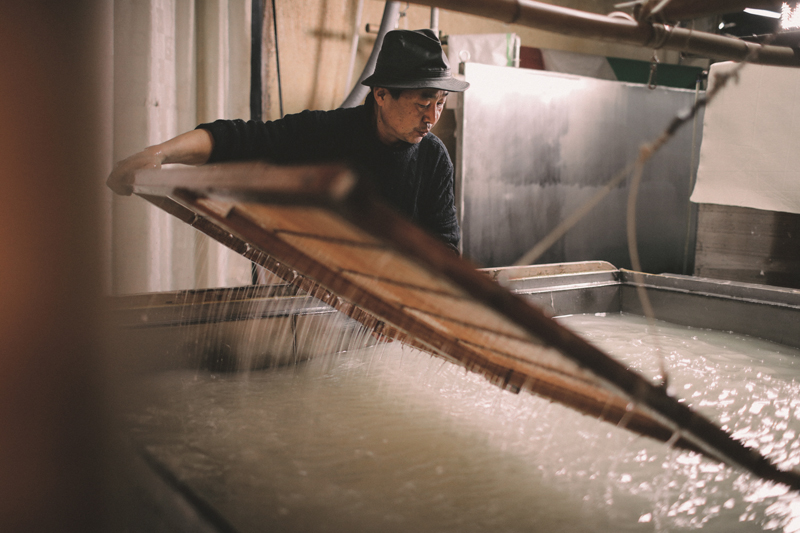
Master artisan Jang Sung-woo of Jangjibang, a fourth-generation family workshop in Gapyeong, Gyeonggi Province, demonstrates the traditional single-screen method of making hanji. By gently shaking a suspended screen from side to side while repeatedly scooping and draining water, the papermaker ensures the mulberry fibers settle evenly, producing paper of uniform thickness and exceptional strength, one sheet at a time.
Courtesy of the Korea Craft and Design Foundation
Hanji achieves a rare balance among such strict parameters. Made from long, resilient mulberry fibers, it has a tightly interwoven internal structure. This allows hanji to maintain high tensile strength even when fashioned into extremely thin sheets, and to resist disintegration when folded or moistened. When applied over an original artifact, it performs its necessary function without asserting its presence. Moreover, the microscopic pores formed between fibers absorb and release moisture, acting as a “breathing” buffer between disparate materials — paper, wood, textiles, and pigment layers. In climates where seasonal humidity fluctuates significantly, this quality is particularly valuable.
The material properties of hanji are now being empirically examined and documented in active restoration settings. Gruppo 130°, a network of Italian conservation specialists, has conducted comparative studies applying hanji alongside Japanese washi in the restoration of artworks. Their evaluations have focused on wet strength, flexibility, surface characteristics, and workability. In this context, hanji is being treated not as an unconventional traditional Asian paper but as a functional material subjected to the rigorous technical standards of conservation science.
At the Vatican Museums, hanji has entered the academic sphere as a new material for training conservation specialists. The proliferation of symposia and official programs dedicated to this Korean paper demonstrates that it is no longer a subject of fleeting interest but has entered the institutional discourse. Gone are the times when hanji was an unfamiliar name in European conservation circles; it is now increasingly recognized as a material comparable to established conservation papers. This development raises the question whether the traditional techniques of hanji production are being transferred alongside export of the paper itself.
TECHNOLOGY TRANSFER
The key to expanding hanji’s presence in the global restoration market is surprisingly obvious: it’s not enough to sell the paper; knowledge of how to use it must also be shared. A sheet of conservation paper does not fulfill its purpose through the material alone; it requires hands that understand it. The conservator must know how to mix the mulberry paste to the right consistency, when to apply moisture and when to withhold it, when to lift a damaged layer, when to press surfaces together, and how to fine-tune color and texture.
Japanese materials have remained the international standard for conservation not only for their quality but in the cultivation of a washi-specific network of conservators through long-term training. For hanji to follow a similar path, not only the material properties of conservation-grade traditional paper but also the techniques for handling it must be systematically transferred.
To tackle this issue, in 2025 the workshop “Traditional Korean Method of Paper Dyeing” was held for conservation specialists, linking the Vatican Museums with the Fabriano Paper and Watermark Museum in Italy. It sought to move beyond the mere supply of hanji to trans-ferring related technology, so that conservators can independently produce and apply natural pigments. Particular emphasis was placed using natural materials to reliably reproduce the brown tones most frequently required in restoration settings using natural materials.
The process involves creating colors that harmonize with the discoloration of the artifacts being restored, using locally available materials such as alder bark, onion skins, acorns, and gallnuts. This is more than straightforward dyeing instruction; it is a process of recreating materials that can age gracefully alongside the artifacts themselves.
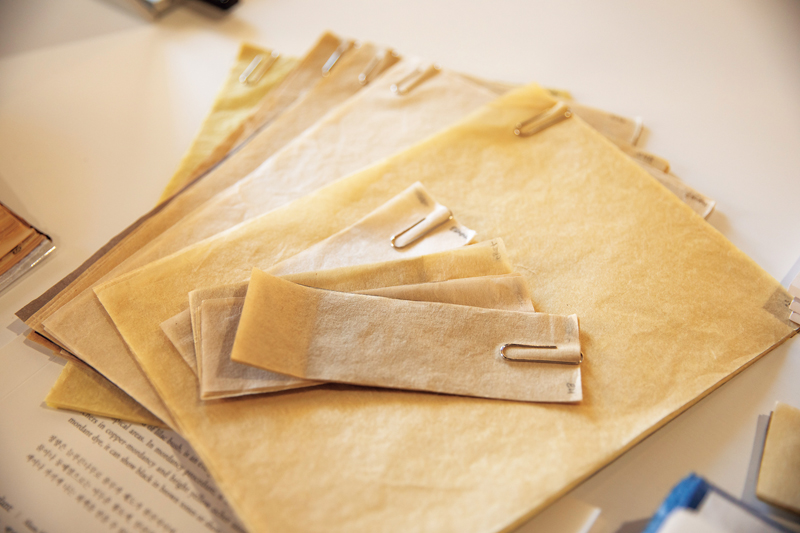
Experimental studies demonstrating the exceptional durability of hanji have drawn international attention to its potential as a conservation material. In Europe, particularly in Italy and the Vatican, this traditional Korean paper is increasingly being used to restore cultural heritage objects, such as this sample housed at the Vatican Museums.
Courtesy of Lee Seung Chul
REGIONAL TRADITIONS
Hanji is not one single type of paper but a collective term for sheets of varying qualities produced across different regions, each shaped by distinct climates, water sources, raw materials, and techniques. While major domestic production centers such as Uiryeong, Mungyeong, Goesan, and Jeonju all utilize the same raw material — mulberry fibers — centuries of tradition have resulted in papers with significantly different textures and grains.
Thanks to the knowledge of local artisans bestowed with National Intangible Cultural Heritage titles, Uiryeong, Mungyeong, and Goesan continue to produce hanji with distinct regional characteristics in terms of physical properties and strength. Meanwhile, Jeonju has cultivated a broader hanji culture by linking the paper with industry, tourism, and craft. Andong emphasizes the versatility of hanji and its connection to traditional lifestyle crafts. This regional diversity is a distinct advantage in the field of conservation. Because artifacts requiring restoration vary widely in condition and composition, no single type of paper can solve every problem. The availability of materials with differing physical properties provides conservators with a broader spectrum of choices.
COLORED HANJI
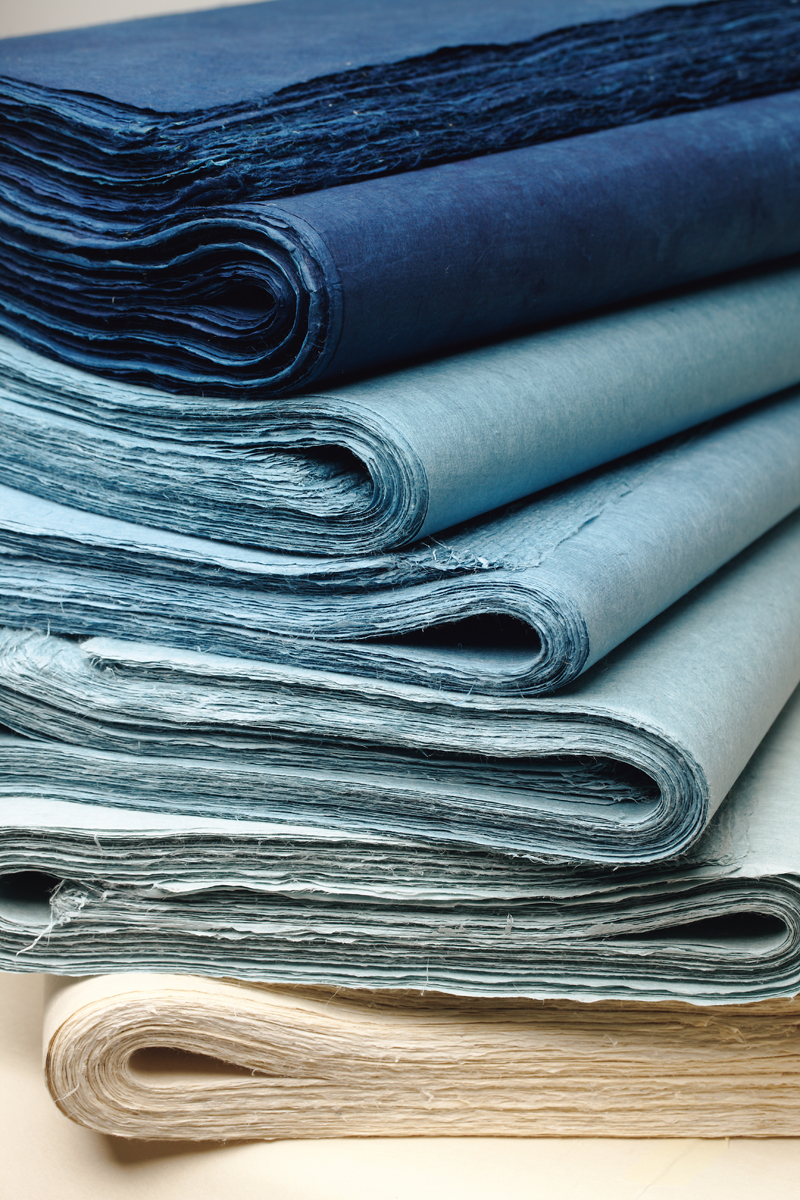
Naturally dyed hanji imbued with a deep blue hue. After the mulberry bark is thoroughly steamed in a cauldron and the outer bark is removed, the fibers are immersed in indigo dye to produce this colored paper.
Courtesy of Lee Seung Chul
Traditionally, hanji was colored through natural dyeing. In this context, color was not merely decoration but an intrinsic quality. The way hanji fibers retain pigment, the depth with which they filter light, and the grain that remains visible on the surface make colored hanji a complete material in itself. However, the production of authentic colored hanji has become increasingly difficult in modern times. Natural dyeing typically follows one of two methods: seonyeom (pre-dyeing), in which the raw fibers are steeped in color before the sheet of paper is formed; and huyeom (post-dyeing), where the paper is dyed after the finished sheets are made. Of these, the pre-dyeing method has all but disappeared. This has created a paradoxical situation where papermakers often lack knowledge of natural dyeing, and dyers are unfamiliar with the craft of hanji. Consequently, colored hanji is often made through chemical post-dyeing — an imperfect substitute for natural processes.
Nevertheless, colored hanji is the realm where the paper’s expansive potential is most evident. For instance, if the natural brown tones required in cultural heritage restoration can be accurately reproduced, colored hanji could transform from a decorative material into an integral component of restoration practice.
Today, hanji occupies a modest position in the global conservation paper market. Yet its tangible attributes — its regional diversity and capacity for long-term preservation — are undeniable advantages on the international stage. That hanji is now being employed in restoration, one of the most cautious and rigorous fields, is evidence of its technical potential.
Perhaps the path forward for hanji lies not in discovering a new role but in returning to its oldest mission: to protect records and artifacts through its time-tested endurance. When it can properly fulfill that role once again, hanji could be chosen as the paper that preserves the world’s memories.
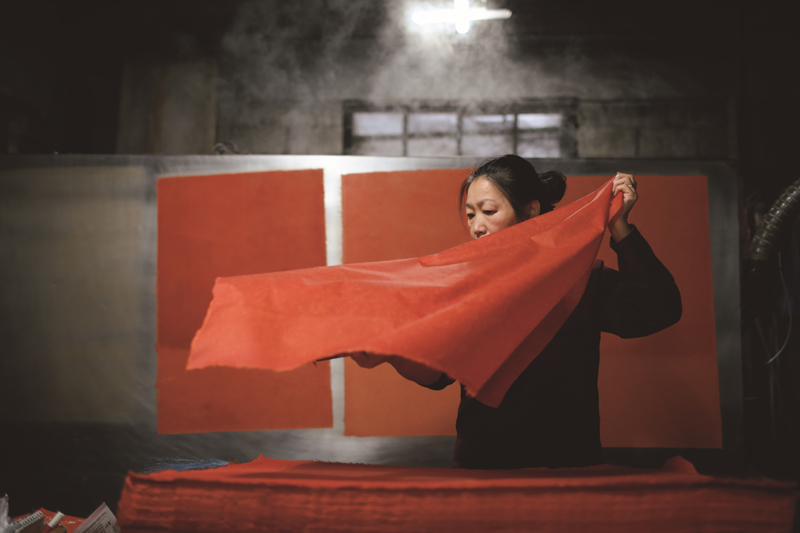
The city of Wonju has long been recognized as a major center of hanji production, celebrated especially for its wide variety of colored papers. Wonju Hanji, a third-generation family enterprise, has developed over 230 kinds of naturally dyed paper, significantly contributing to the preservation and broader appreciation of this traditional craft.
Courtesy of the Korea Craft and Design Foundation
 한국국제교류재단