Kim Soo-ja has been on the road most of the time for the past 25 years or so, expressing life through her fabricworks. The current exhibition, which comes four years after the New York-based artist’s previous show in Korea,is titled “Kim Soo-ja — Archive of the Mind.” The nine works presented at the National Museum of Modern andContemporary Art, Seoul, show how her needlework is approaching ever closer to the origin of humankind.
“Archive of the Mind” (2016), by Kim Soo-ja, is an installationfor audience participation, consisting of an oval table with adiameter of 19 meters. Visitors knead clay at the table listeningto “Unfolding Sphere,” a 16-channel sound performance.
Wherever she appears, her silhouettewill catch your eye. Wearinglong, black clothes with her longhair simply tied, Kim Soo-ja has the imageof an ascetic seeking truth. The simple styleof the artist, almost nearing her sixties,reveals the consistency of her art world.Sitting on a heap of wrapped bundles, hertrademark bottari, she has wandered inthat style like a Zen master around majorcities of the world, circling the globe severaltimes.
In her first solo exhibition in Korea aftera long break, Kim reviews the traces ofher 30-year career, apparently putting itinto order. In particular, she seems to havewrestled with the question of how to induceviewers’ participation and communicatewith them naturally. Stepping down fromher position as an internationally renownedartist, and taking a break from her murderoustravel schedule, she holds out a handto visitors, suggesting they take a momentto join her in pondering the question: “Whathas made me so immersed in my work?”
Sitting on a Heap of Bottari
The first work that vaulted Kim Soo-jaonto the international art scene was the“Bottari Truck.” It was photographer JooMyung-duk who made her known to theworld with his landmark photo of her sittingon a heap of colorful bottari, with herback to the camera. This photo elevatedone woman artist’s creative experimentsfrom the commonplace wrapping of thingsto a truly unique concept of connecting people.For Kim, who depicts people throughfabric, the needle is a tool in her hand andextension of her body — an extension ofher heart, in fact. Kim recalls the momentwhen she “encountered” the needle: “As Iwas stitching a quilt with my mother, I realized,through the movement of the needle,the natural course of life and death, inhalationand exhalation, and yin and yang.”
She had already begun to search for thedeeper meaning of life while she was an artstudent at Hongik University: “I decided tobecome an artist because it was the way Icould live my life contemplating its deeper meaning.” Pondering how to reveal the structureof the world, in a way that can express the vertical and horizontal on a two-dimensional surface,she felt her encounter with sewing was opening the door to her artistic journey. Thecharacteristics of bottari — two dimensional when unfolded but three dimensional whenwrapped — made it the ideal tool and concept for Kim, who sought to embrace every realmof humanity’s magnanimity, flexibility, and variability.
“My name, Soo-ja, sounds like the Hindi word for needle,” Kim says. Then, had her fatebeen predetermined? Kim saw herself as a needle when moving through the middle of acity in conflict and discord. Following the “Bottari” series, her subsequent work on “A NeedleWoman” and “A Mirror Woman” series made her one of the busiest artists in the world.
Destined to Wander
What would be the most objective standard for assessing an artist’s international fame?In the past, it was most often the prices that an artist’s works could fetch at an auction orglobal markets. Now there is another criterion: flight mileage.
Kim Soo-ja keeps a hectic schedule, spending five months of the year in New York, whereshe has lived since 1999, one month each in Seoul and Paris, and the remaining five monthstraveling from city to city for solo and invitational exhibitions. Art journalists receive emailsfrom Kim Soo-ja’s studio on a nearly weekly basis, informing them of her latest and upcomingshows.
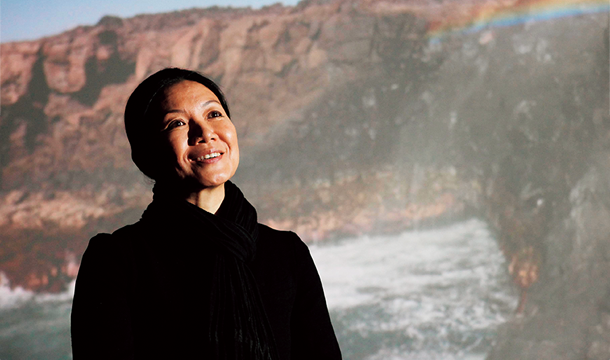
Kim Soo-ja stands in front of her video work,“Earth, Water, Fire, Wind.” Six pieces out of thisseries were installed on the oil retaining wallat the Yeonggwang Nuclear Power Plant (laterrenamed Hanbit Nuclear Power Plant) in 2010.
Kim’s works are inspired and based on the new ideas and tools of her global journeys;the essence of her work is the people she encounters on the road. Through the people whoare her medium, the artist also has evolved. She says her work is characterized by “spatiality, spirituality, and identity,” but theoverriding theme is people and the futurethey create. “Earth, Water, Fire, Wind,” aninstallation unveiled in September 2010 atthe nuclear power plant in Yeonggwang,South Jeolla Province, is a video work thatexpresses the reality of the Korean Peninsulawhere nuclear threat looms. At thenuclear power plant, which contains thedual meaning of the destructive potentialof nuclear power and its possible future tohelp address our energy needs, the artistexposes the perspective of a nomad withthe message: “Rely on the natural circulationof earth, water, fire, and wind.”
Cutting Off the Edges of the Heart
Upon entering the exhibition “Archive ofthe Mind” (July 27, 2016–February 6, 2017),visitors are confronted with a gigantic ovaltable with a diameter reaching some 19meters. Far too large for an ordinary room,the table can be seen as an image of themind or a galaxy, depending on one’s perspective.Visitors can take a seat at thetable and knead a ball of clay, feeling thetexture, something they seldom get to do.While rolling the clay around, they mightthink, “Why do I have to make only a ball?”But the artist’s intentions are expressed inthis method of participation.
“Deductive Object” (2016). Steel, paint, mirrors.Sculpture 1.5m (D) x 2.45m (H). Mirror 10 x10 m.
As she explained in a talk session abouther exhibition, “It’s a place where you canempty your heart and cut off the edges.”There are so many edges in human affairs.The edges of conflict and division can leadto terrorism and war. The rotating action oftouching and rolling the clay with the handsleads visitors to look into their inner stateof mind. It enables them to feel somethingfrom the friction in their palms. The primitivetactile sensation and repeated handmovements enwrapping the void, suddenly evoke the circular illusion of nothingness.
The new sound performance work, “Unfolding Sphere,” exhibited along with the titlepiece of the exhibition, overwhelms the audience with a cosmic sense of space that correspondsto the image of the table’s surface scattered with clay spheres.
Traces of the Body
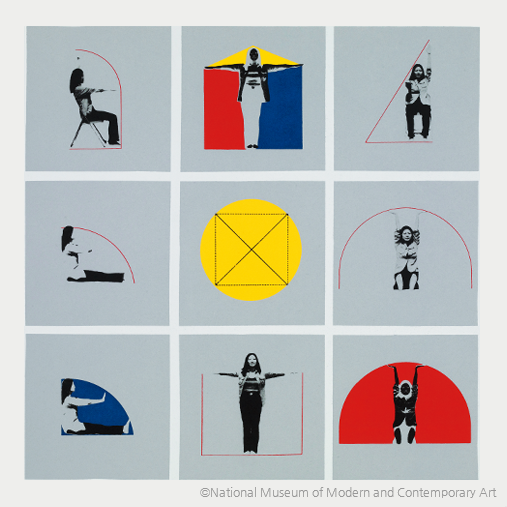
“A Study on the Body” (1981). Series of silkscreenphotos of Kim’s own performance. Each photo 54.5 x 55.5 cm.
“Geometry of the Body” consists of a yoga mat hanging on the wall, the actual mat thatthe artist has used for the last 10 years, devoting herself to the exercise. It’s a kind of “bodypainting” with traces of the touch of hands and feet, the sweat and tears that have broughtchanges to the material. The mat here is not a ready-made object of the sort that has beenused in art for a long time, but a “used object” that reflects the traces of the body. Such traceshave created a new concept of painting.
Since deciding to become an artist, Kim Soo-ja has inquired into the question of thevertical and the horizontal. “A Study on the Body,” from 1981, is a visualof herattempts to answer this question during her early days. In this series of 45 silkscreen photosof her own performances, the body seems to be the base from which she perceives herselfand the world as well as the root of her work.
“One Breath” is a digital embroidery piece that records the waves of inhalation and exhalation.The artist gave shape to the structure and form of breathing, as a prerequisite ofsurvival, by pushing the needle through the fabric. While looking at the cycle of breathingembroidered on the satin fabric, one comes to wonder about the border between life anddeath. This work was based on the graphic depiction of sound waves in “The Weaving Factory,”a breathing sound performance presented in 2004.
"Deductive Object," the casts of two arms alone on a wooden table, looks lonely. Is it because it represents the void? The thumband index finger on each hand of the artist’sown casts are touching each other.
Kim Soo-ja is known as “bottari artist,” because shefirst received attention with her performance of sittingon a truck loaded with cloth-wrapped bottari, asshe traveled around the world.
A few women are weaving and unweaving something, employing themselves as human needles.Perhaps that’s all there is to the path walked by humankind — being sewn into nature, breathingin and out, and permeating the void.
From Bottari to Anthropology
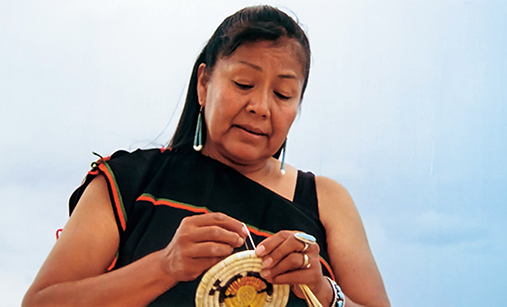
“Thread Routes V” (2016). Still images from a 16mmfilm with sound, 21 minutes 48 seconds.
The finale of the exhibition is the newchapter (Chapter V) of the serial work“Thread Routes,” which is being shownfor the first time. While traveling aroundthe world, since 2010 Kim Soo-ja has beenmaking a 16mm documentary film seriestitled “Thread Routes,” of which the fifth ofsix installments is now complete. Explorationof the world’s weaving culture, atheme the artist has pursued throughouther entire career, is contained in a video of21 minutes 48 seconds. It was filmed on areservation for Indians in the New Mexicoarea, which is home to Navajo and Hopipeople, the original natives of the Americancontinent. Critics have called this work a“visual poem without narrative” and “visualanthropology.”
On a remote plain that gives rise toimaginings about the origin of mankind, the desolate ruins reminiscent of the Stone Age,lofty stone peaks, and the distant horizon reveal themselves as the base of the screen.
Afew women are weaving and unweaving something, employing themselves as human needles.Perhaps that’s all there is to the path walked by humankind — being sewn into nature,breathing in and out, and permeating the void.
The little needle woman who used to sew small bundles, has now become a great needlewoman sewing the earth, traveling the galaxy, as always.
 한국국제교류재단