Ram Han — the professional moniker of Han Jihye — cultivates tension between the grotesque and the sublime, set against a sleek, dreamlike palette of fluorescent hues. By transmuting the digital texture of the screen into a profound painterly experience, she articulates a new visual lexicon for the digital age, one that resonates powerfully with the sensibilities of her generation.
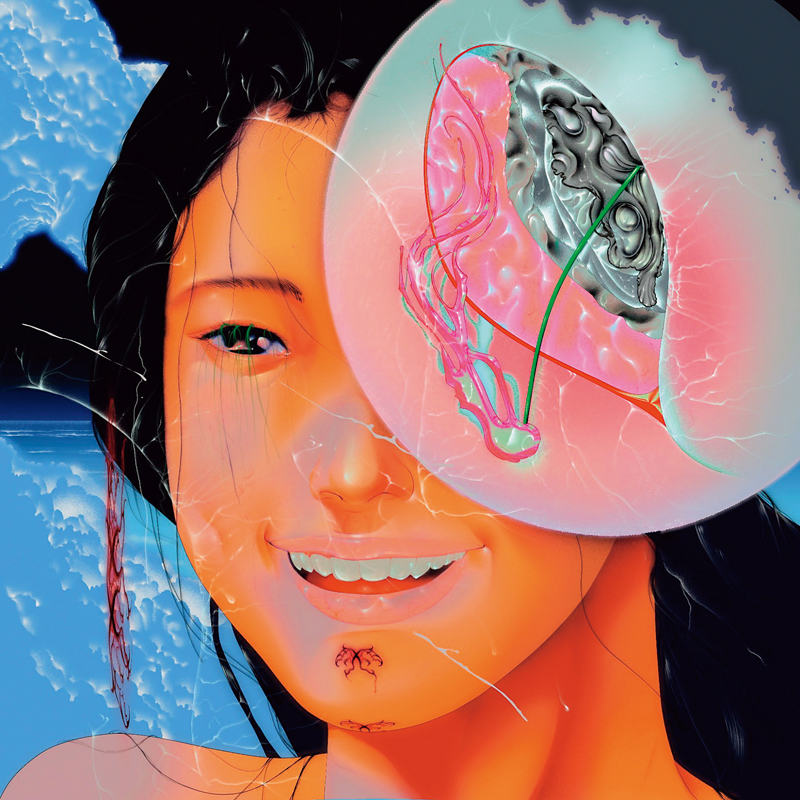
“Case_01_01 (Toxin).” 2020. Archival pigment print, light panel. 100 × 100 cm.
Commissioned for Words at an Exhibition – An Exhibition in Ten Chapters and Five Poems at the 2020 Busan Biennale.
© Ram Han, Whistle
While digital artist is the conventional shorthand for creators who use technology, Ram Han introduces herself as a “digital painter,” a far more deliberate, specific designation. Forsaking traditional brushes and oils, she composes her world through tablet styluses and pixels. She captures ephemeral thoughts and mundane scenes on her smartphone, using these digital archives as the foundation for sketching and rendering on a graphic tablet. Her process is defined by spontaneity — from the initial stroke to the final flourish — leveraging the iterative nature of digital files to endlessly refine and update her visions. By framing the act of dabbing color and tracing lines on a screen as a definitive act of painting, she invites the viewer to focus on the painterly qualities of her medium. In an era of digital ubiquity, calling herself a digital painter reminds us that the very boundaries of the medium should be reconsidered.
FROM BLOG TO MUSEUM
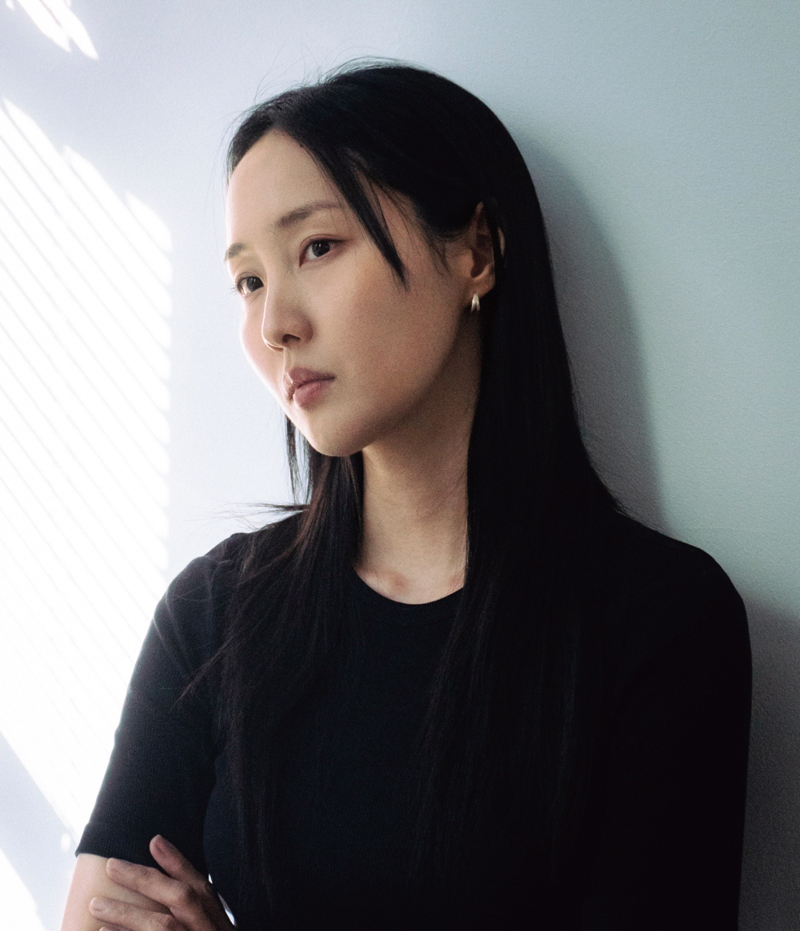
Based in digital environments, Ram Han’s work presents a distinctive worldview where the virtual and the real, along with memory and fantasy, intermingle. Subcultural influences permeate the artist’s practice, fostering a passionate following among a younger audience.
© Ram Han, Whistle
The name “Ram Han” is the artist’s professional moniker, a combination of Ram, derived from her childhood nickname “Ramji” (squirrel), and her family name Han. The digital realm has always been a primary stage for her creative activity; since her late teens, she has used the virtual space of NAVER blogs to disseminate her comics and illustrations. While studying animation at the Korea National University of Arts, she consistently shared personal projects on Instagram (@ram__han). This digital presence paved the way for high-profile collaborations with global brands and entertainment powerhouses such as Apple, LG OLED, HYBE (formerly Big Hit), and SM Entertainment, alongside prestigious book cover commissions. She gradually expanded her artistic footprint through independent publications and boutique exhibitions, notably her debut solo show, Nightcap (2017), at Your Mana in Seoul, and the publication of her book of illustrations, Let’s Meet at 7PM.
Ram Han entered the institutional art world in 2018 through the group exhibition Phantom Arm at the Buk-Seoul Museum of Art. The curator, who discovered her work through social media, recognized her as an artist who uses the digital virtual world as a creative stronghold to experiment with media and form. After building her practice in the digital sphere, Han translated her aesthetic into a large-scale physical installation for the first time. Her “Room Type” series — monumental digital paintings, each measuring three meters square — marked the genesis of her inquiry into how works conceived inside the computer could be tangibly manifested outside of it.
To faithfully replicate digital textures in a physical environment, she developed a light-panel system featuring archival prints on backlit film illuminated by a rear LED source. Taking hotel rooms as its motif, this series features surreal juxtapositions: a closet repurposed as a row of fish tanks, a white rabbit leaping onto a bed, and an airplane passing by a circular window. By decontextualizing these spaces to amplify their fantastical elements, the nostalgic color palette and composition evoke the vibrant yet desolate atmosphere of the love hotel scenes in Isshin Inudo’s 2003 film Josee, the Tiger and the Fish.
A MILLENNIAL ARTIST’S WORLDVIEW
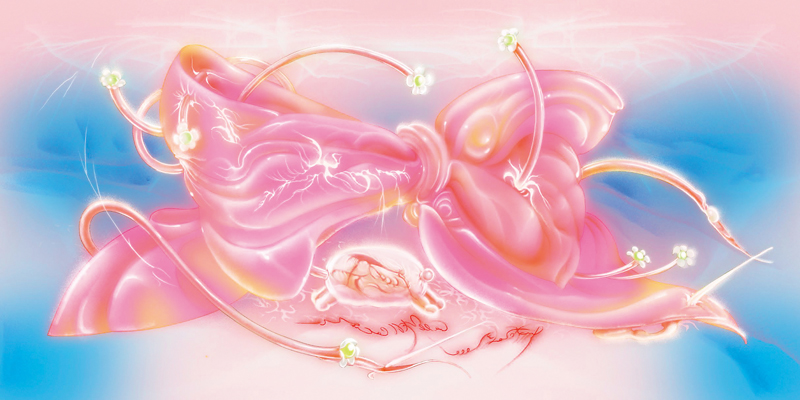
“Save Our Souls_05.” 2022. Archival pigment print. 14 × 28 cm.
© Ram Han, Whistle
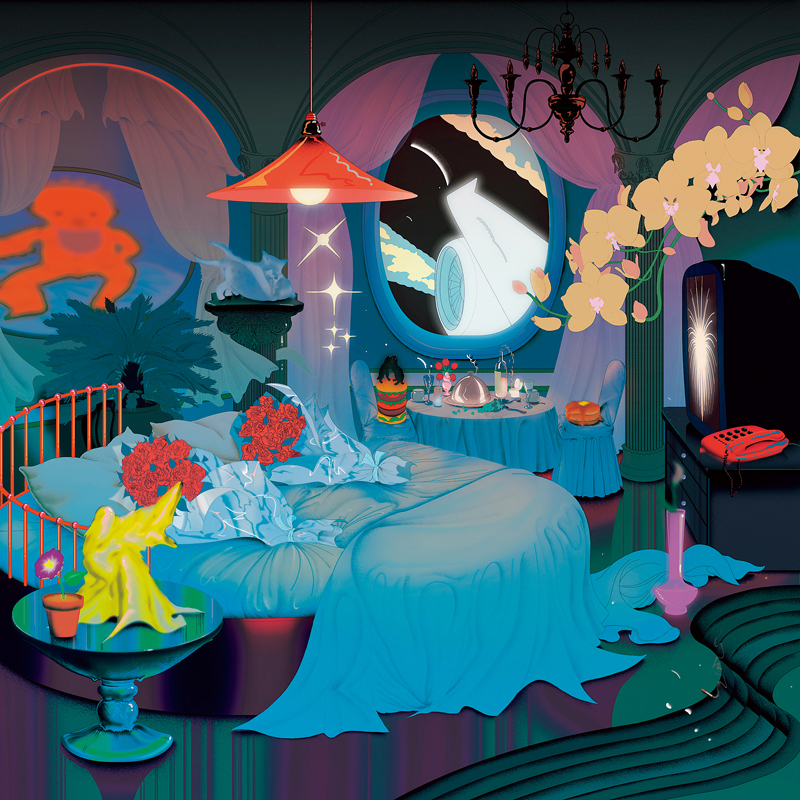
“Room Type 02.” 2018. Archival pigment print, light panel. 300 × 300 cm.
Commissioned for the 2018 exhibition Ghost Arm at the Buk-Seoul Museum of Art in northeastern Seoul. Collection of the Buk-Seoul Museum of Art.
© Ram Han, Whistle
Kyungmin Lee, director of Whistle, a gallery in Seoul’s Itaewon neighborhood, notes, “While reducing an artist’s work to mere generational theory can be limiting, the way Ram Han selects her subjects and constructs her narratives deeply mirrors the interests of her contemporaries.” Born in 1989, Han’s aesthetic is rooted in subcultures like manhwa (Korean comics), animation, and gaming. She came of age immersed in anime, heavily influenced by the uniquely beautiful yet macabre visual language of Japanese manga. Furthermore, the expansive player agency and the synthesis of Eastern and Western aesthetics found in the 1999 Nexon multiplayer online role-playing game Elancia form the foundation of her creative imagination. To this day, she continues to explore the worldviews of new gaming titles as they emerge.
Her references also include sci-fi cinema, such as Christopher Nolan’s 2014 epic Interstellar, and the visual culture of collectible figures. The cyber-chic aesthetics of late 1990s and early 2000s Korean pop music — typified by Uhm Jung Hwa’s “Molla” (Don’t Know) and Lee Jung-hyun’s “Bakkwo” (Change) — are reassembled on her canvas, merging with millennial memory. Meanwhile, the raw, unfiltered imagery encountered during the early years of the internet left lasting visual and emotional imprints, now condensed into the vibrant, neon-saturated textures of her palette.
Following the Phantom Arm exhibition, Han has consistently engaged with the institutional art world, participating in the 2020 Busan Biennale (Words at an Exhibition), the 2023 exhibition Game Society at the National Museum of Modern and Contemporary Art, Korea (MMCA), and the 2024 Korea Arts Management Service (KAMS) exhibition DIALOGUE: I Am Because We Are.
Her commercial work is equally compelling. In her book cover designs for the sci-fi and fantasy genres, she deftly translates complex narratives into striking visual compositions. Her work for the special edition of Chung Serang’s School Nurse Ahn Eun-young (2015) captured the award-winning novel’s supernatural aura and turned the volume into a coveted item. Her covers for Kim Bo-young’s Saba Samsara (2024) and Bora Chung’s Your Utopia (2025) are evocative portals into the heart of each narrative.
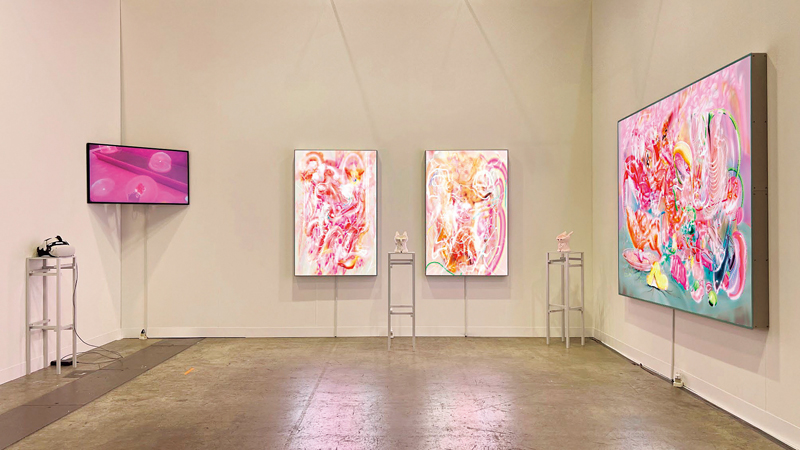
Installation view of Art Basel Hong Kong 2023.
© Ram Han, Whistle
FROM DIGITAL TO PAINTERLY
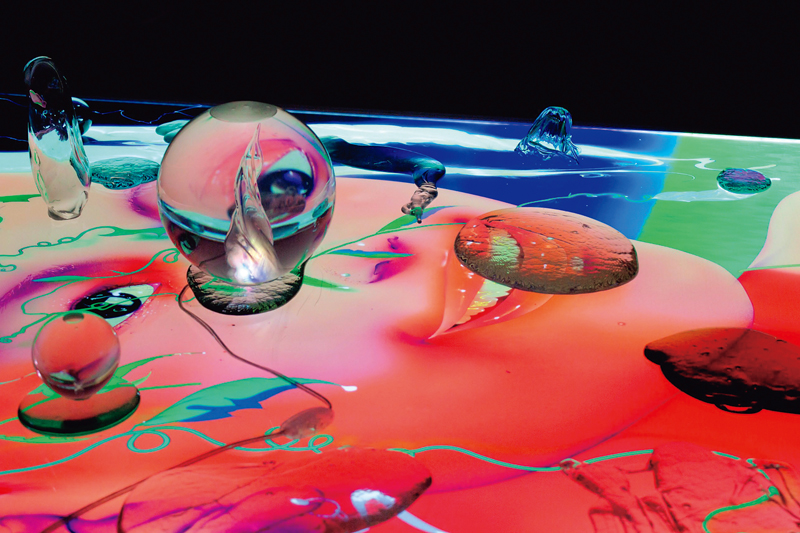
“Expectancy.” 2019. Archival pigment print, light panel. 150 × 150 cm.
Installation view of Ghost Shotgun, a two-person exhibition held in 2019 by Ram Han and Hayne Park at the Audio Visual Pavilion, an independent art space in Seoul.
© Ram Han, Whistle
Ram Han’s solo exhibitions at Whistle in Seoul — Spawning Scenery (2022) and Inaudible Garden (2024) — distilled her ambitions and inquiries as a digital painter. The former featured works where the artist pushed the limits of the digital screen, interrogating the density of color and the sensation of the surface. In “Souvenir Study (Hatchery),” visceral, shimmering masses of psychedelic hues, amorphous and electric, tangle and explode across the frame. Through hybrid creature drawings and the VR piece “Uninvited-Tamagotchi,” Han reconfigures mass-media memories into layers of fantasy, transforming the viewer’s gaze into an intimate, immersive experience.
In the Inaudible Garden exhibition, she refined her approach through the garden motif, focusing on flora and the female form. Although the “Tulip” series explicitly references the flower, the archival prints on backlit film don’t immediately come across as botanical forms. Instead, Han first renders a complete tulip, then enlarges, duplicates, and reassembles fragments, layering them with new drawings like a cryptic script. This trajectory toward abstraction is a deliberate maneuver to assert the unique identity of digital painting.
Han continues to experiment with printing and reproduction techniques to ensure viewers perceive the subtle nuances native to the monitor: the specific grain of light, the digital bleed of color, and the fine tension between pixel and brushstroke. Ultimately, her work is less about the adoption of new tools and more about expanding perception. Though her stylus serves as a brush and pixels are her pigment, she remains fundamentally engaged in the act of painting, solidifying “digital painter” as a rigorous and enduring mode of artistic practice.
 한국국제교류재단