Chungju and Danyang in the central inland province of North Chungcheong are full of spectacular scenerywith rocky cliffs that descend to the waters of the Namhan River. Jungangtap, or the “Central Tower,”located in the middle of Chungju, is a monument left behind by Silla when it unified the ancient ThreeKingdoms in the seventh century. It continues to stand today, marking the nation’s geographic center.
The rain fell softly.
As old stories go, rain is a welcome gift for travelers. When mountains and fields, flowersand trees are quietly obscured in the rain, so does the traveler escape the web of lifefor a moment.
Coming off the expressway, I parked the car by the road leading to Jungangtap-myeon, the“Town of the Central Tower,” in Chungju. Taking a deep breath, I said hello in my mind. WheneverI’m about to enter a city, breathing deeply is an old travel habit of mine. When I think of thetraces of the lives of people who have lived on this land for generation after generation — theirpain and joy, sorrow and longing, the dreams they harbored, and the despair they suffered, allfloating in the air somewhere — I’m filled with a sense of awe. For a long time, it’s been mybelief that the greatest cultural heritage of any city is the air that hovers over it.
The Chungju locals like to call their city Jungwon, or “the midlands.” (Until 1995, its administrativename was Jungwon County.) They take pride in the fact that Chungju is the geographicaland historical center of Korea. Any traveler will come to agree after spending just a couple ofnights in the city. Embracing this city, formed alongside the Han River flowing through the centerof Korea, are a legacy of old pagodas and monuments that attests to its past.
Land of Warriors
The first place I wanted to visit to pay my respects was the Goguryeo monument. Though itis now officially called the Chungju Goguryeo Monument, many locals are still in the habit ofcalling it the Jungwon Goguryeo Monument. It is the only stone stele of the ancient kingdom ofGoguryeo remaining in South Korea. The stele is presumed to date back to the mid- to late fifthcentury, when Goguryeo, founded in present-day northeast China, also known as Manchuria,had expanded its territory southward to the central part of the peninsula. Part of the inscriptioncarved on the surface says, “Goguryeo and Silla were like brothers, and the Goguryeo king presentedsome garments to the Silla king and his officials,” giving a glimpse at relations betweenthe two ancient kingdoms.
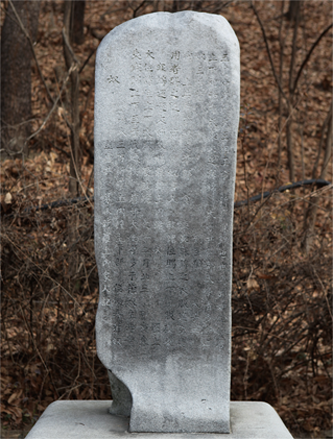
The Goguryeo Monument in Chungju isthe only Goguryeo relic of its kind remainingin South Korea. Standing 2.03 metershigh, it was presumably erected in the fi fthcentury.
The stele is on display in an exhibition hall built near the spot where it was discovered andnext to a wooded slope nearby is a replica of the monument; the hall and its displays serveto educate visitors on the history of Goguryeo, which for the most part ruled the territory thatis now North Korea. A replica of Anak Tomb No. 3, North Korea’s National Treasure No. 28,is reproduced in 3D computer graphics.Clearly depicted in the tomb murals aremembers of the Goguryeo cavalry calledgaemamusa, or “iron horse warriors.” Consistingof soldiers and horses fully cladin armor, the cavalry comprised the raidingunits whose attacks broke through theenemy lines as well as the protective forcethat defended against attacks. At the heightof its power, Goguryeo is said to have possessedan iron horse cavalry force of morethan 50,000 warriors. In Western history,armored horses did not appear till muchlater: the earliest known record dates backto the battle between the Persians andMongols in 1221.
In 668, Goguryeo fell to Silla, the neighborit had for some time seen as its subjectand younger brother. It is not hard to imagine the Goguryeo monument’s subsequent fate, consideringthat it stood in the middle of a road in the “midlands.” Some believethat Goguryeo refugees, fearing persecution, would have buriedthe stele underground, while others speculate that it may havebeen used as an anvil stand at a blacksmith’s workshop, whereit endured centuries of hammer strikes and puffing bellows, itsinscription battered and distorted almost beyond recognition.
Symbol of a Unified Nation
I turned my steps to the seven-story stone pagoda in Tappyeongri,my nextof tribute in the region. The Chungju locals like tocall this pagoda the Jungangtap, meaning the “Central Pagoda.”Indeed, the current name of the administrative district to which itbelongs was changed to Jungangtap-myeon, the “Town of the CentralPagoda.” Silla, which conquered its two neighbors Baekje andGoguryeo after many years of war, erected this pagoda in the middleof its territory. Around sunset, I circled the pagoda three times.The number had no particular meaning, but I was thinking aboutthe Three Kingdoms — Silla, Goguryeo and Baekje. All three hadcompeted fiercely with each other, pursuing the dream of makinghistory and creating an advanced civilization, but eventually, Sillaemerged victorious. As I circled the pagoda, I could feel a strange,inexplicable energy emanating from it.
I love the energy surrounding ancient pagodas. Once on a visitto the Khajuraho monuments in India, I sat in the shade of a stonestupa and wrote as many as 30 poems in half a day. Likewise, Iwrote dozens of poems in one day at the Taj Mahal in Agra. Circlingthe shade of an old pagoda, I can almost hear the breathing and geta whiff of the smells of the people who over the ages dreamed andsang songs as they walked around it.
The road following Chungju Lake toDanyang passes by spectacular craggykarst landscapes and views of the windingcourse of the Namhan River. The famous“Eight Views of Danyang” can be seen up1 close by taking a ferry cruise.
The Song of the Balmy, Rainy Night
Tangeumdae is another place to visit if you want to fully appreciatethe geographical and historical significance of this region. In 552, during the reign of King Jinheung, a man named Ureuk cameto settle in Silla. He was from Gaya, a small state to the south ofSilla, where music and rites were deemed highly important. There,he had invented a 12-ed zither named gayageum and composed12 beautiful pieces of music for the new instrument; the 12s of the instrument represented the 12 months of the year.The Silla king warmly welcomed this eminent musician and hadhim stay in Jungwon to teach music to court musicians. Tangeumdaeis the riverside rock where Ureuk played the gayageum. Thesound of plucking its s would have exquisitely complementedthe picturesque scenery of the winding river. There is indeed somethinggratifying about the way the ancient kings placed importanceon rites and music as their tools for ideological guidance in stateaffairs. I wondered what a utopia is. What people value the most inlife nowadays doesn’t seem all that different from those who livedhundreds of years ago.
In Chungju, there is a place called Muhak Market. This lovelyname somehow evokes the image of merchants and shoppersdancing joyously like cranes around each other. The market takesthe shape of a fishbone, with a long central path forming the spineand smaller paths branching off to the left and right. I followed thespine and made a turn into one side road, then another and yetanother, until I managed to lose my way. There is nothing wrongwith wandering around a market and getting lost, but finding mycar posed a bit of a problem. After wandering about some more, Isaw an old traditional house named Banseonjae. This is the housewhere Ban Ki-moon, the former United Nations secretary-general,grew up. The name reflects the goal of living in “a good and uprightmanner.” Unable to find my way back through the maze of smallpaths, I circled around the market on its outer rim. The happinessat finding my car two hours later was accompanied by a fit of hunger.I went into a place selling hot noodles, where the serving ladygave me an extra bowl of rice. It was as if she knew I was famished.
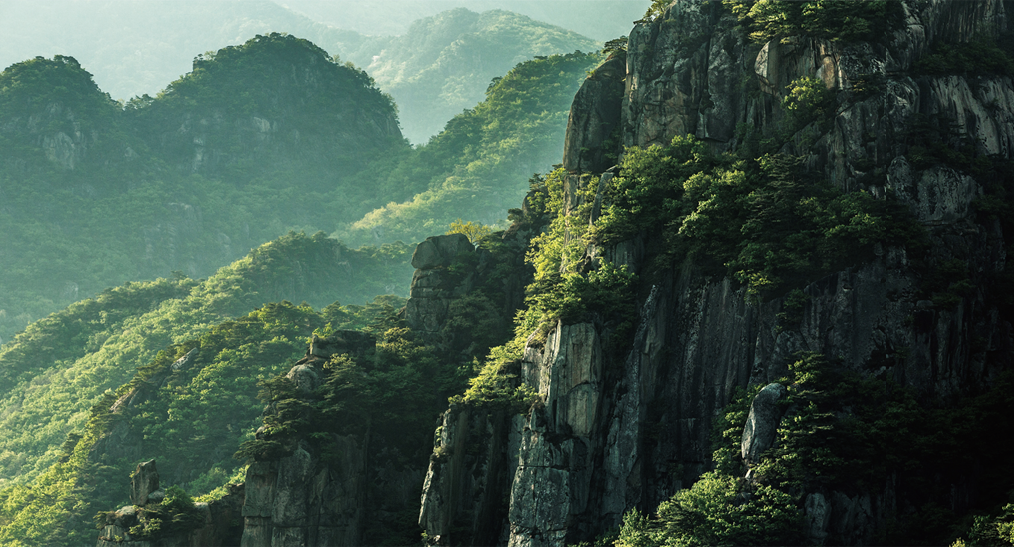
Oksunbong, or “BambooShoot Peak,” is so namedbecause of its bluish-whiterocks that rise up into theair just like fresh bambooshoots. It is one of the mostprized of the “Eight Views ofDanyang.”
If there are no signs of human life, beautiful natural landscapes often seem incomplete. The beauty ofnature gains utopian charm when the spirit of the people who lived there seems palpable.
That night in my room, I opened the window and listened to therain falling all night.
Back in the days of Silla and Goguryeo, there would also have been those who opened their windows and listened to the rain fall throughout the night. Was there apiece about the rain among Ureuk’s 12 works, of which no trace remains today? A song about the soundof the rain on a night when the flowers bloomed? I dare say there was one. In the morning, the rain keptfalling softly and quietly.
Reveries at the Old River Port
Driving along the river on Road No. 599, I headed for Mokgye Ferry Port. Since the Joseon period, thelargest market along the Namhan River has flourished here for centuries. Back then, products from theeast and west coasts were traded here, and boats carrying grains paid as taxes in the three provinces ofChungcheong, Gangwon, and Gyeongsang, stopped here on their way to the capital. The waterway wasopen from March to November, and in July and August, when the rains swelled the rivers, even the biggermerchant vessels stopped here. Traveling by water, it took around 12 to 15 hours to reach Seoul, andgoing against the current, it took anywhere from five days to two weeks to return to Mokgye. During theJoseon era, some 800 households lived in the riverside village, and 100 boats were regularly dockedthere, which gives a good idea of the size of the port. On the hillside is a monument inscribed with thepoem “Mokgye Market” by Shin Kyung-rim.
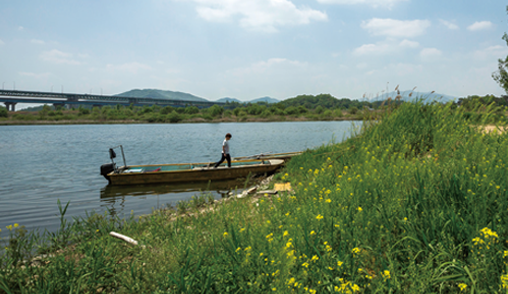
Mokgye ferry port, whichwas the center of watertransportation on the NamhanRiver during the JoseonDynasty, is now a departurepoint for river boat rides fortourists.
The sky urges me to turn into a cloud,
the earth urges me to turn into a breeze;
a little breeze waking weeds on the ferry landing,
once storm clouds have scattered and rain has cleared.
To turn into a peddler sad even in autumn light,
going to Mokgye Ferry, three days’ boat ride from Seoul,
to sell patent face powders, on days four and nine.
The hills urge me to turn into a meadow flower,
the stream urges me to turn into a stone.
— From “Mokgye Market” by Shin Kyung-rim; translated by Brother Anthony of Taizé

When the ferry goes 200 metersupstream from Dodam Sambong, astone arch like a cave entrance huggingthe water can be seen on the leftbank of the river
I was lucky. The river market opens on the fourth Saturday of every month. That was the day I arrivedthere. The market is a kind of flea market, but all the goods on sale are handmade. I liked everythingthat I saw. I had two seals made, one inKorean script and one in Chinese characters,both of which turned out wonderful.Then I bought some cheonggukjangand doenjang (both typesof soybean paste, the former muchstrongerin taste) and citron jam as wellas a wooden figurine and a small purse.When I paid for a few key rings, my walletran dry. The mindset of people whomake things with their hands can besummed up by the Korean word jeongseong,which means putting your whole heart into what you are doing. People who workthis way are generally benign; I believe benignpeople do not harm others. They are the verypeople who make our world worth living in.These people at the market told me that in Aprilthe riverside gets covered in yellow rapeseedflowers and so I should visit again around thattime next year.
Ferry Ride on Chungju Lake
It is hard to express in words the beauty ofthe trip along Chungju Lake to Danyang. Theendless road follows the water. In the misty rain,the road was warm and comforting. It seemedas though it would never end, no matter how faryou went. But everything that has a beginningalso has an end. About an hour later, I stoppedthe car at Janghoe Ferry Port. For quite sometime, I had meant to take the Chungju Lakeferry from there. But the raindrops began togrow bigger. I wondered if the ferry would sail atall, but surprisingly, there were a lot of passengersand the boat got completely filled.
I wondered about Gudambong (“Turtle Pond Peak”) and Oksunbong (“Jade Shoot Peak”) on the lake,two of the Eight Views of Danyang.
Would I get a good view of them? The scenery here was a favoredsubject for famous Joseon artists such as Kim Hong-do and Jeong Seon, and Confucian scholars suchas Yi Hwang wrote that it was even more beautiful than the Eight Views of the Xiao and Xiang Rivers inChina. But the rain had no intention of letting up. Grabbing my umbrella, I headed for the deck. The airwas filled with rain and mist, the sky covered in clouds, and sadly, the sights were not to be seen. Thenagain, it was too much to expect spectacular views on my very first trip here. My encounter with the twopeaks, which I had longed to see since reading Shin Kyung-rim’s poem “Mokgye Ferry” in the 1980s, hadto wait until the next time.
Dodam Sambong is an island composedof three rocky peaks sitting inthe middle of water in the upstreamreaches of the Namhan River.
Landscapes and the Lives of People
When I got back on the road, the rain began to thin. In front of me, I could see Dodam Sambong(“Three-peak Island”), its three rocky peaks rising above the water’s surface in a bend of the upperreaches of the Namhan River. A famous British traveler came here in the 19th century. Isabella BirdBishop, the first woman fellow of the Royal Geographical Society, described the scene in her book,“Korea and her Neighbors”: “The beauty of the Han culminates at To-tam [Dodam] in the finest riverview I had then ever seen, a deep stretch with a broad bay and lofty limestone cliffs, between which, on agreen slope, the picturesque deep-eaved, brown-roofed houses of the village are built.”
Bishop had seen two things: the picturesque peaks of Dodam and the thatch-roofed houses on thehill. If there are no signs of human life, beautiful natural landscapes often seem incomplete. The beautyof nature gains utopian charm when the spirit of the people who lived there seems palpable.
At Dodam, I climbed the steps till I was some 300 meters up the steep mountainside and went about100 meters down again until a gateway of stone appeared. The blue-green water of the river can beseen between the caves. The ideal world of nature carries a certain dignity. I wonder how Bishop managedto get here at the end of the 19th century, when transportation would have been difficult at best.From where I stood, I could see the lights in the village come on one after another, shining beautifullythrough the rainy air.
 한국국제교류재단