The Netflix orginal KPop Demon Hunters, released in June 2025, continues to captivate global audiences of all ages and has rapidly emerged as a cultural force in its own right. Its impact extended well beyond the screen: The film not only won Best Animated Feature Film at the 98th Academy Awards, its featured track, “Golden,” took home an Oscar for Best Original Song as well as Best Song Written for Visual Media at the 68th Grammy Awards. The film’s virtual girl group, HUNTR/X, also performed at the 79th British Academy Film Awards (BAFTA). Indeed, the film’s meteoric rise shows no signs of slowing.
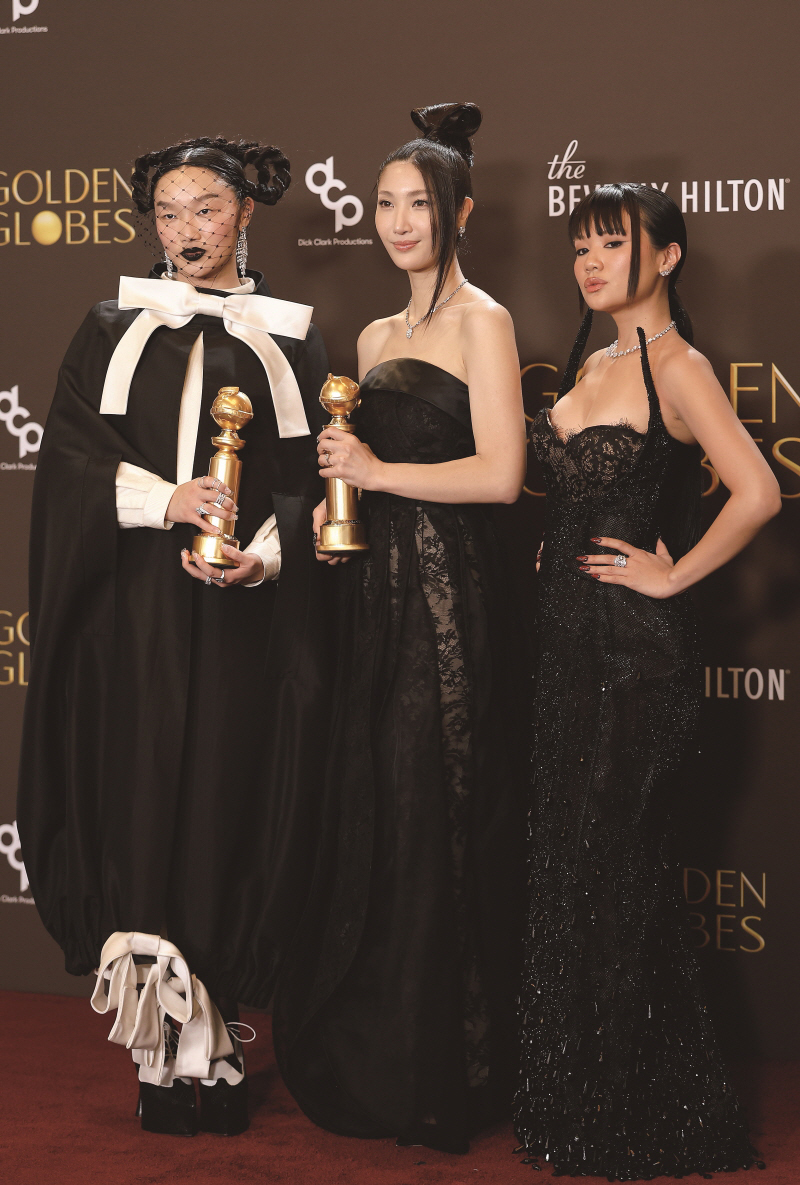
At the 83rd Golden Globe Awards, held this January at the Beverly Hilton in Los Angeles, Maggie Kang’s Netflix original KPop Demon Hunters won Best Animated Feature and Best Original Song. Pictured from left: Audrey Nuna, EJAE, and Rei Ami, the singing voices behind the girl group HUNTR/X in the film, pose after the ceremony.
ⓒ Yonhap News
KPop Demon Hunters demands a word stronger than “success.” What unfolded after its release amounted to a cultural juggernaut. The film rewrote Netflix’s record books, becoming the first title on the platform to surpass 300 million views in 13 weeks. The next milestone was almost inevitable: It seized the top spot in Netflix’s all-time cumulative viewership rankings. Once momentum gathered, the trajectory refused to flatten. While most blockbusters begin to cool after three months, this one didn’t.
Clear lines between good and evil, brisk storytelling, and a cast with undeniable charm gave the film everything audiences could want. Yet the true binding element — which caught viewers’ attention — was the music. In this regard, the film’s success recalls not so much other animated features as the Pinkfong Company’s breakout sensation, “Baby Shark.” Songs of this order, including “Let It Go” fromFrozen, transition quickly from catchy to inescapable, especially among children and teenagers.
TRUE TO THE K-POP SPIRIT
The excitement of audiences replaying the same songs and videos spilled beyond televisions and smartphones to the big screen. As theaters continued to face uncertainty in the wake of the COVID-19 pandemic, KPop Demon Hunters stepped in as a sing-along event, drawing viewers into the film as active participants. Opening on August 23, 2025, in more than 1,700 theaters across North America, the film sold out nearly 1,000 screens and debuted at number one at the box office.
Though an animated feature, KPop Demon Hunters unfolds as a musical built on the grammar of K-pop, a combination that all but ensured the success of the sing-along screenings. International media outlets ran near-daily reports on audiences braiding their hair into long purple plaits to mimic the heroine, Rumi. From the opening track “How It’s Done” to the climactic “Golden,” fans sang along at full voice and embraced the energy that drives the narrative from start to finish.
When the title KPop Demon Hunters first appeared, many longtime K-pop fans likely dismissed it as another attempt to exploit the genre’s formidable power. Their skepticism was warranted. As the popularity of K-pop soared, attention often drifted away from the music itself and toward the explosive energy of its fandom. That force had grown impossible to ignore; even the famously hard-to-impress Anglo-American media and long-standing music awards found themselves caught in its orbit. The pull was powerful enough to attract supporters and skeptics alike. But the K-pop fandom had seen this before and knew the difference between those who came for the music and those who came for the spoils.
However, KPop Demon Hunters was clearly distinct from those opportunistic projects, which becomes clear the moment one watches it. At its core, the story is simple: a heroine hiding a secret meets an adversary with a story of his own. The two connect, there is a betrayal, and in the end — with his help — she manages to save the world from evil. Though it follows the classic superhero formula many of us grew up with, the texture of the world it inhabits sets it apart. K-pop flows through the film, alongside glimpses of Korean culture and familiar scenes of Seoul.
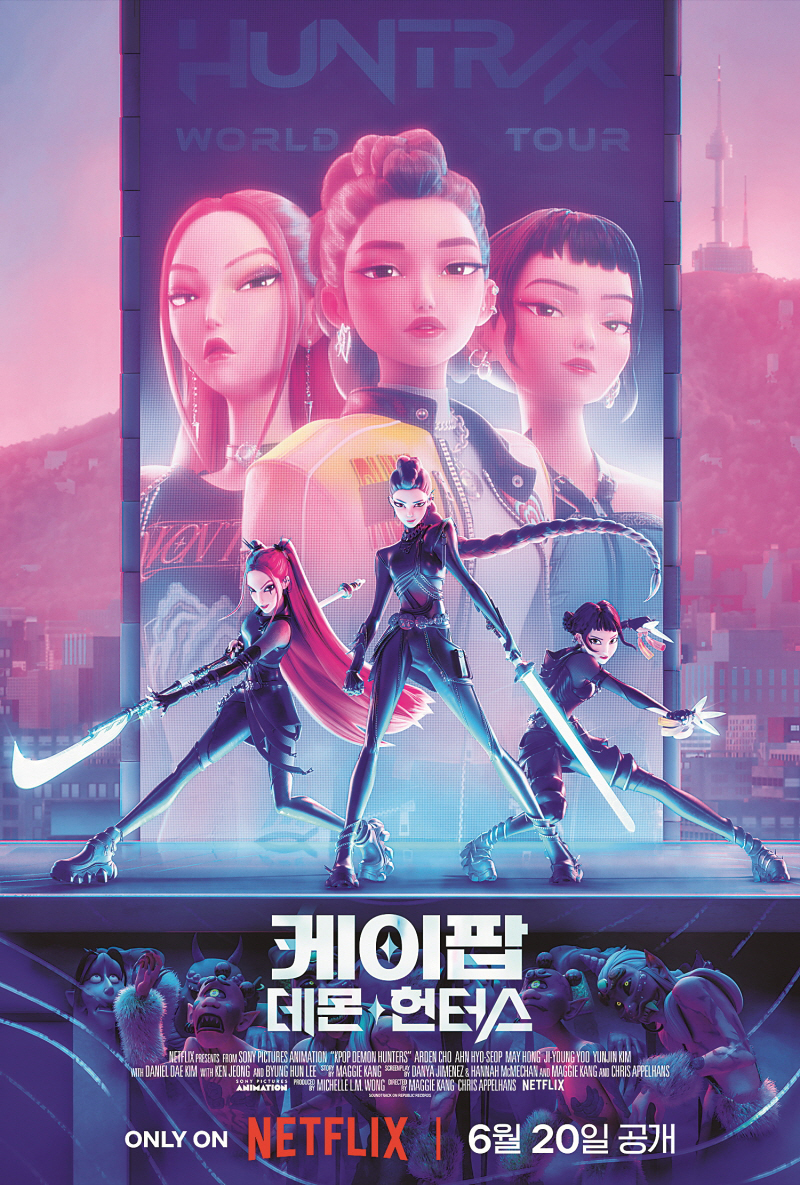
The KPop Demon Hunters soundtrack caused a sensation. Despite being performed by fictional idol groups, it achieved remarkable musical success that rivaled — and even surpassed — that of real K-pop stars.
ⓒ Netflix
GIRL GROUP REIMAGINED
At first glance, the story is fairly conventional, but the film’s distinct identity and the individuality of its characters rest entirely on K-pop. Take the trio of “demon hunters” introduced in the opening scene, heirs to a legacy handed down through generations. Anyone even casually familiar with K-pop, or with Korean popular music more broadly, would spot their inspirations at once. From the Kim Sisters, widely regarded as the pioneers of Korean female pop ensembles, to the country’s first dance trio Settorae and later first-generation idols S.E.S., the fictional group HUNTR/X trio captures the ideal form of the K-pop girl group almost to perfection. As the story takes shape, it feels only natural to grow fond of them: lively yet emotional, unpretentious yet commanding, bound by a sisterhood as strong as family.
HUNTR/X sing and dance throughout the film. Their major rivals, Saja Boys, match them step for step. For anyone who follows K-pop, the patterns are unmistakable. The song “Soda Pop” captures the bright, fresh-faced concept that every rookie boy group is expected to master. “Your Idol” recalls the many groups that declared their passage from boys to men. And “How It’s Done” calls to mind the girl groups that cast off restraint to reveal the charisma they had long kept hidden. The references are deliberate and impossible to miss. More striking still, each of these songs carries traces of K-pop’s original blueprint, the version that seemed to recede in the 2020s amid the industry’s rush toward global expansion and the rise of easy listening. Among fans, the phrase “a group project by professors” caught on for good reason. It conveyed the sense that KPop Demon Hunters carried the mark of seasoned K-pop experts who had united to deliver a masterclass with remarkable polish.
OST: K-POP’S BEATING HEART
KPop Demon Hunters also tapped into K-pop’s underlying originality. The driving force behind the soundtrack is THEBLACKLABEL, founded by producer TEDDY. This record label and creative agency is the architect behind the sound of acts such as BIGBANG, 2NE1, and BLACKPINK, and a key force in YG Entertainment’s rise to the pantheon of K-pop’s three major agencies. After breaking away from YG in 2021 to chart its own course, the label soon signed on to the KPop Demon Hunters project. Producers who worked on the album describe it as a truly enjoyable collaboration, a sentiment echoed by everyone involved. Built on mutual respect across cultures, the project was grounded in K-pop’s time-tested formula, bringing together producers who had already broken into Western pop markets through groups like BIGBANG and 2NE1, among the first K-pop artists to gain real traction there. That track record mattered. In the English-speaking world, where chart success rarely comes without the scale of global heavyweights such as BTS or BLACKPINK, the KPop Demon Hunters OST drew an unusually strong response.
Backed by producers who knew the K-pop playbook inside out, the project surged forward. The OST’s popularity rivaled, and at times eclipsed, that of the film itself. Led by the title track “Golden,” which held the No. 1 spot on the Billboard Hot 100 for eight consecutive weeks from mid-August 2025, two months after its release, nearly every song on the soundtrack won listeners over. In a striking sweep, eight tracks entered the Billboard Hot 100 simultaneously, with three landing in the Top 10, and the whole soundtrack hit top spot on the Billboard 200 album chart in September. Whenever momentum threatened to dip, the music and the film kept each other in the spotlight. The Golden Globes, the Academy Awards, and the Grammys all took notice. Regardless of the final tally of trophies, the film’s popularity shows no sign of fading, continuing well into the first half of 2026.
For years, K-pop relied on the fierce devotion of its fandom, which often inspired awe in those outside that circle. The world seemed less interested in what the fans loved than in what made them love so intensely. That dynamic is already changing. The raw energy at the heart of K-pop has found new forms in film and music, extending its reach far beyond its original base. Once viewed from a distance, K-pop is now being embraced. The narrative stands poised for a definitive shift.
 한국국제교류재단