Released in October 2025, The World of Love is the first feature in six years from director Yoon Ga-eun, an up-and-coming filmmaker drawing growing attention at home and abroad for her accomplished cinematic language. Acclaim from industry greats, critics, and audiences fueled a groundswell of encouragement to view the film.
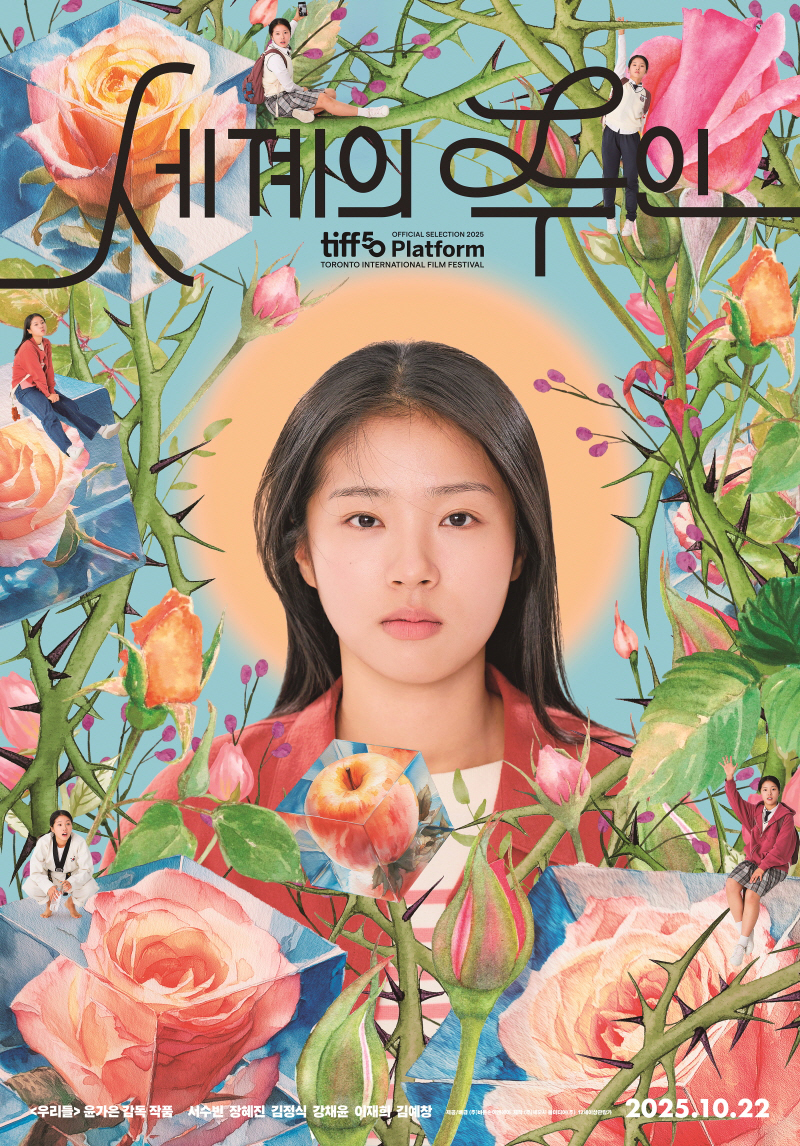
Released in October 2025, The World of Love, directed by Yoon Ga-eun, was widely praised by both critics and audiences. The film went on to garner numerous awards at festivals in Korea and around the world, including the Grand Prize at the Festival des 3 Continents in Nantes, France.
ⓒ Barunson E&A
The World of Love opens immediately with an indelible moment. The screen is black and the only sound is a request to imagine a kiss. Then the emptiness gives way to the flushed face of an excited lover. A boy and a girl in high-school uniforms come into view, but the focus is on the latter. Her gaze suggests confidence, as if the film is ready to reveal the full intensity of her bearing.
For viewers familiar with Yoon Ga-eun’s earlier work, the opening is a subdued gesture, a quiet farewell to the essence of her previous works. A kiss lies far from her usual emotional landscape. From her debut, The World of Us (2016), and its follow-up, The House of Us (2019), to earlier shorts such as Guest (2011) and Sprout (2013), Yoon has explored how children form relationships with friends, family, and the world around them. Sexuality was purposefully sidelined in those storylines as her films lingered over aspects of childhood itself — gentle smiles, unguarded tears, and the slow shaping of personality and character.
Through the years, Yoon has repeatedly spoken in interviews about her interest in adolescence, particularly the love and sexuality of teenage girls. She imagined her long-time admiration for teen romance would eventually lead her to explore the genre. But in an interview with Cine21, she acknowledged that completing a fresh, youthful project proved far from easy.
“Sex and love cannot be separated from fear, anxiety, unease, worry, or from the incidents that ripple through society,” she said. Rather than opting for simple or saccharine storylines, Yoon uses that sense of confusion in her scripts, and The World of Love can be seen as a culmination of her oeuvre thus far.
ANOTHER KIND OF VIOLENCE
After a passionate kiss, Jooin (played by Seo Su-bin) jokes around with a friend who draws risqué comics. Unsure what kind of adult she wants to become, she remains untroubled even during career counseling with her homeroom teacher. At home, she lives with her younger brother who is absorbed in practicing magic tricks, and her mother, a kindergarten director who tends to drink a little too much. The father’s absence has left quiet scars on this family, yet the three are grounded, going about their daily lives.
The film presents Jooin as the kind of spirited figure one might find in any ordinary classroom, her rougher edges registering as a natural feature of her age group. Still, there’s a mystery surrounding her persona, which surfaces when her classmate Suho (played by Kim Jeong-sik) organizes a school petition opposing the release of a convicted child sex offender. Jooin refuses to sign. As her response escalates from refusal to open anger toward a campaign that appears, at first glance, uncontroversial, the audience begins to ask why. Why does Jooin react this way, and why does she resist so intensely?
What provokes Jooin is the language of the petition itself: Suho’s attempt to block the offender’s return to society stresses the fate of victims, portraying the lives of sexual-violence survivors as destroyed. That is simply unacceptable to Jooin for she herself has been the victim of familial sexual abuse. By refusing to sign, she makes her point with stark simplicity. Unbowed, she says, “Even if my uncle committed an irreversible act against me, my life has not been destroyed, and it will not be.”
The film does not stop at affirming the dignity of victims. It pushes forward, dismantling the very conception of a “proper” victim. After Jooin discloses her experience of abuse to her classmates, she suffers from misunderstanding, suspicion, and isolation. The anonymous notes she receives become the clearest symbol of the fallout.
Yoon places the audience in the position of the unseen sender. While the film challenges the arrogance of understanding a survivor solely through the lens of victimhood, it also pulls back, acknowledging that it cannot fully grasp Jooin’s inner truth.This stance finds its most vivid expression during an emotional car-wash scene. As the car carrying Jooin and her mother moves through the clattering machinery, her anger rises in a scream that is gradually swallowed by the noise of the water. The moment does not offer catharsis, instead hovering between confrontation and hope as her mother quietly suggests: “Shall we go through once more?”
LAYERED PERSPECTIVES
The characters in The World of Love move through the reality of sexual violence in different ways. Some endure its pain directly, while others, as family members, grapple with guilt. Still others who suffered similar experiences find themselves unable to stand tall, their wounds deepening over time. There are also those who regard sexual violence with detachment, convincing themselves that it does not involve them. Taken together, these positions gradually come to mirror the unspoken thoughts that surface in the minds of viewers as the film unfolds.
The anonymous notes extract the questions each character may have. The callousness that demands to know how Jooin can remain so unaffected and presses her to remain silent leads into a different kind of confession at the film’s end.
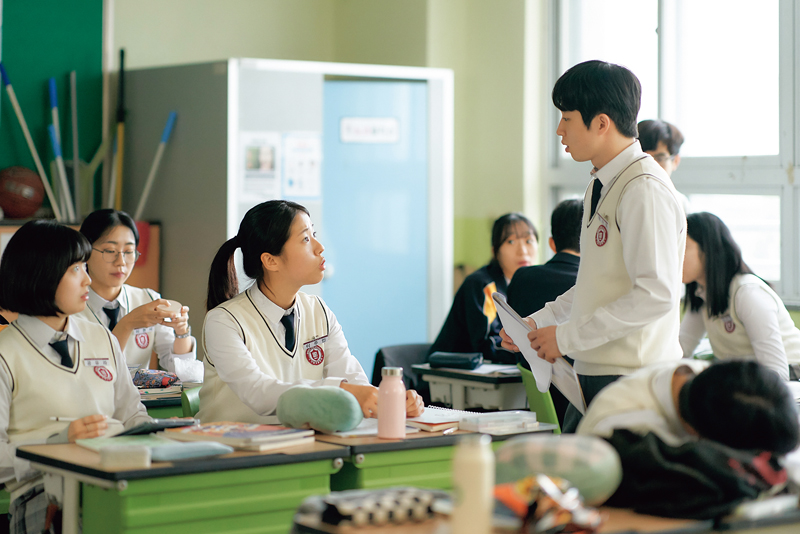
Over the years, Yoon has developed a distinctive cinematic voice, portraying human relationships and social dynamics through the eyes of children. Her third feature film, The World of Love, focuses on a high school girl who has suffered familial sexual abuse, thereby expanding and deepening the thematic concerns that run through Yoon’s earlier works.
ⓒ Barunson E&A
I went through the same thing as you. But I couldn’t live the way you did. To stand steady myself, I will not forget you. These words are delivered in dozens of voices, none tied to a single individual. At once tender and chilling, the voices reveal that what once sounded like a threat came from another survivor. To underline the message that Jooin must be able to say she is hurting when she is in pain, the story discloses that she once pinched a child, Suho’s younger sibling, a student at her mother’s kindergarten, to make her admit she was hurting too.
The film confronts the audience with two questions. Do we extend solidarity only when a victim appears unblemished? And can a survivor of sexual violence also become a different kind of perpetrator? Jooin writes that her dream is “love.” We are left to wonder what we can do, together, to make that love possible? This is where The World of Love reveals its quiet strength.
EMBRACE AND SUPPORT
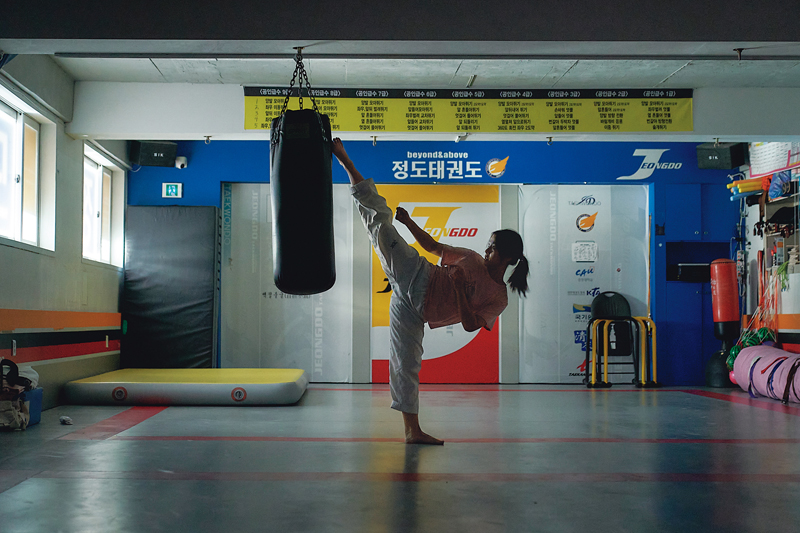
Whereas many earlier films dealing with sexual violence have tended to adopt a strongly denunciatory tone, The World of Love takes a markedly different approach. Rather than recreating the moment of violence or dwelling on the depths of despair, it offers a sensitive and unconventional portrayal of a person who doesn’t allow emotional wounds of the past to impede their ability to embrace the present and future.
ⓒ Barunson E&A
The year 2025 saw the release of films from both Bong Joon-ho and Park Chan-wook, as well as a new work from Hong Sang-soo, who adds a new title on an almost annual basis. Amid the offerings by these artists, long regarded as the giants of Korean cinema, many domestic publications named Yoon Ga-eun’s The World of Love as the “Korean film of the year.” As of early February 2026, it had drawn roughly 200,000 viewers, a figure rarely reached in the nation’s independent and arthouse film scene. This reflects the outpouring of support from directors such as Bong Joon-ho and Yeon Sang-ho, actors including Kim Hye-soo and Kim Tae-ri, and countless viewers.
The World of Love also attracted attention outside the country, screening at the Toronto International Film Festival, the Warsaw International Film Festival, the BFI London Film Festival, and the Hong Kong Asian Film Festival, among others. Behind its warm reception from both critics and audiences lies not only an attentiveness to the actual realities of survivors of sexual violence but also support for the courage to bring forward stories long considered too difficult to handle.
“Both the welcome and the discomfort surrounding The World of Love felt remarkable to me,” Yoon said, reflecting on that response. “I was grateful for it all.”
By letting long-overlooked survivors speak, Yoon gives a broader view of their lives. Audiences now wonder what kind of work she will produce next to open our eyes anew. For now, attention turns to Naturally, her contribution to the short-film anthology Times of Cinema, scheduled for release in 2026. But cineasts will hope that they won’t be kept waiting another six years before this ascending auteur’s next release.
 한국국제교류재단