There is a very old Buddhist temple in Yeongju, my hometown. Its name recalls a mysterious “floating stone,” or buseok, that is related to the temple’s foundation, laid in the seventh century.
My grandmother, though not quite a full-fledged believer, frequented Buseok Temple to pray for the happiness of her children and especially for me, her eldest grandson. On Buddha’s Birthday, in May, I would accompany her. That required walking 10 li (4 km) to the Buseok marketplace and another 10 li along a lonely valley road.
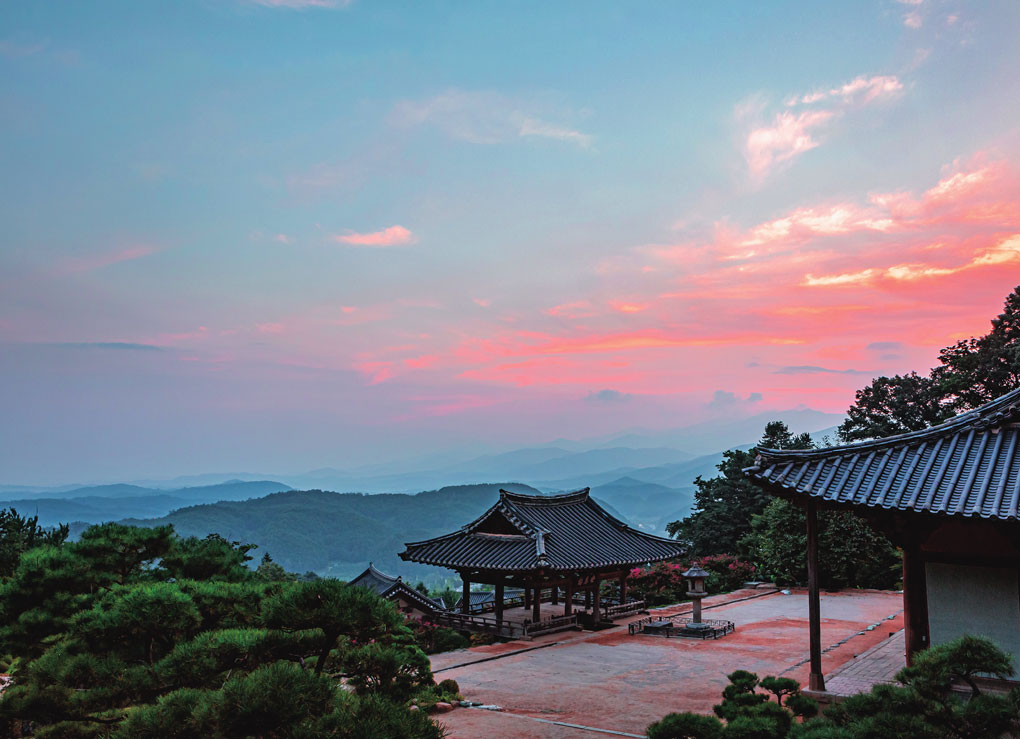
© Ahn Hong-beom
The hike became most demanding at the temple’s front gate, which had a single pillar. A signboard announcing “Buseok Temple, Mt. Taebaek” marked the edge of the secular world. From there, a long, uphill path lined with ginkgo trees and apple orchards awaited us. Next, we’d reach the Gate of the Heavenly Kings, then two bell pavilions slightly to the side and more stone stairs. Next to appear was the Paradise Hall. The number of stairs up to this point was 108, the number of kleshas, or afflictions that plagued the mind. Passing under the pavilion and up more stairs, we would emerge in the yard immediately facing an ancient stone lantern. Behind it was the Hall of Infinite Life, a welcoming sight with the corner of its eaves looking poised for flight. As my grandmother’s faithful follower, I always entered through the side door and bowed three times before Amitabha Buddha.
Behind this hall to the left is the “floating rock.” Its legend, which concerns the love of a maiden, Seonmyo, is narrated in the 13th century history book “Memorabilia of the Three Kingdoms” (Samguk yusa). But I prefer the story told by my grandmother:
“When the king of Silla decided to build a temple here to protect the area with the Buddha’s power, National Preceptor Uisang roamed the mountain pass looking for a proper site. One day, he loosened a big rock with his forefinger and sent it flying into the sky. The rock became a black cloud and floated around for seven days, sending down heavy rain until it finally descended, blessing this spot. But it never actually touched the ground, and so even today, if you place aunder the rock and tug on it, thewill not break.”
I love the sight from the pagoda behind the shrine to the maiden; the raised eaves on the corners of the Hall of Infinite Life; the ridges of Mt. Sobaek seen beyond the Paradise Hall, rising, falling and fading like a fugue; and the breathtakingly lovely evening light that settles on those rolling ridges.
The path behind the pagoda leads to a quiet, modest building with a gabled roof: the Hall of the Patriarchs, where a portrait of Uisang is enshrined. I sit on the hall’s neat, unadorned base and, as I think about the giant rock which is said to float into the sky on quiet nights and look down smiling on the sleeping children, I long for my grandmother.
 한국국제교류재단