The Onyang Folk Museum is Korea’s largest private institution dedicated to the systematic preservation of traditional life. Its vast collection is meticulously organized to reflect the full spectrum of Korean social and cultural practices — from housing and livelihood to rituals and the arts. Outside the exhibition halls, a carefully landscaped garden further enriches the experience, allowing the museum to function as a cultural space that combines historical learning with unhurried leisure.
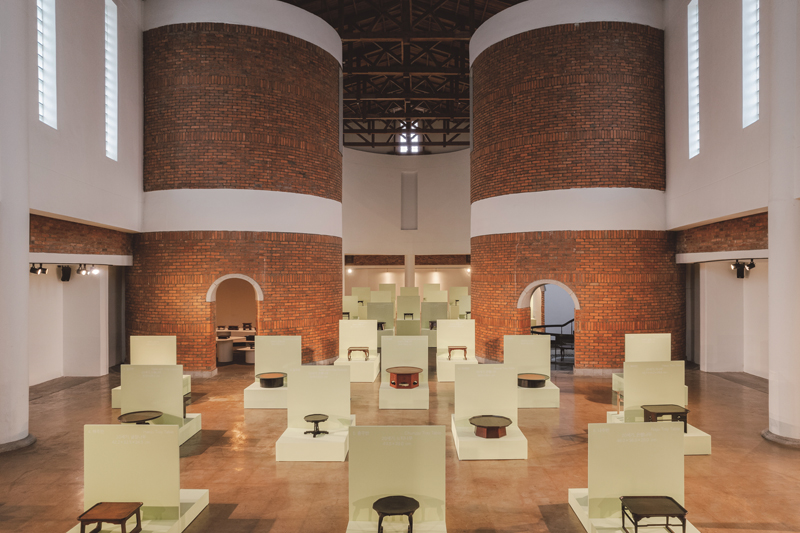
Installation view of Ban-ban-ban: A Generous and Proper Ban, a 2024 exhibition marking the Onyang Folk Museum’s 46th anniversary. The show explored and reinterpreted the diverse uses and forms of soban, traditional small dining tables central to Korea’s floor-seated living culture.
Courtesy of the Onyang Folk Museum
Located in Asan, South Chungcheong Province, the Onyang Folk Museum holds the distinction of being Korea’s first private institution of its kind. On an expansive site of 82,644 square meters, the complex comprises the main building, the Gujeong Art Center, the Asan Craft Center, a café, and a garden, making it the largest privately operated museum in the country. The museum was established in 1978 by the late Kim Won-dae (1921–2000), founder of Kyemongsa, the first Korean publishing house specializing in children’s books. He devoted his personal fortune to creating a haven for Korean heritage.
In the 1970s, as the government’s drive to industrialize and eradicate poverty accelerated, Korea’s traditional folk culture faced the threat of erasure. Alarmed by this potential loss, Kim assembled an advisory group of scholars in folklore, archaeology, and bibliography, and dispatched curators across the country to collect items worth preserving. They gathered everything from traditional garments to rice bowls, small dining tables (soban), plows, and A-frame carriers (jige) — objects found in ordinary homes only a few decades prior that were now rapidly vanishing.
FOLK ARTIFACTS AND THEIR STORIES
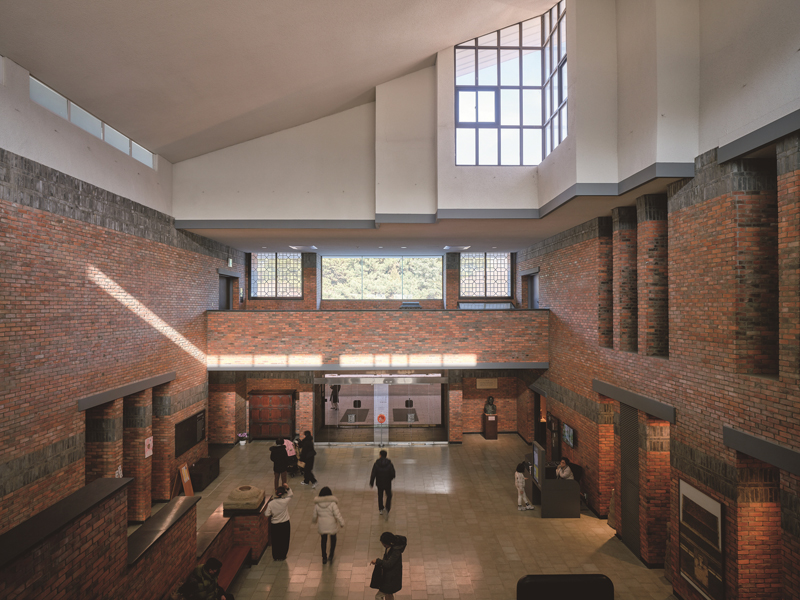
The Onyang Folk Museum’s main building houses three permanent galleries displaying some ten thousand artifacts that illuminate past Korean life. This photograph shows the first floor, where the museum shop is located directly opposite the entrance.
Among the museum’s extensive holdings, several items have been designated as national heritage for their historical and academic significance. These include a bronze gong used in Buddhist ceremonies during the Goryeo Dynasty (918–1392); a late nineteenth century ceremonial armor set — complete with helmet and storage chest — presumed to have been crafted for a crown prince; and a rank badge embroidered with a turtle, said to have been worn by Yi Ha-eung, the father of King Gojong (r. 1864–1907).
The stories behind the collection’s acquisition are also fascinating. One such example is the bronze ritual gong inscribed with “Cheonsuwon,” the name of the temple where it originated, and the date 1162. It was discovered in 1977 near the tomb of Admiral Yi Sun-sin (1545–1598) by a local resident when he began digging the foundations for his house. Mistaking the artifact for scrap metal, he attempted to sell it to a junk dealer, only to be told that it was “not even worth a bar of soap.” On a hunch, he kept the gong and eventually contacted the Bureau of Cultural Property (now the Korea Heritage Service), which connected him with the museum. Upon learning the gong’s true value, the finder declined the compensation offered by the museum’s founder and chose to donate it instead. In 2024, following decades of preservation and research, the bronze gong was officially designated a Treasure under Korea’s national heritage system — 47 years after its discovery.
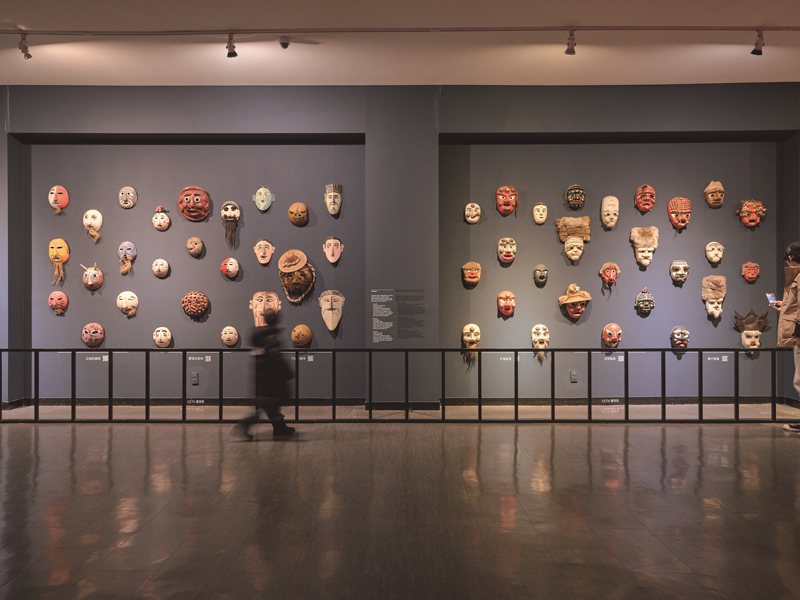
The third gallery features traditional crafts combining beauty and practicality, alongside artifacts reflecting Korean folk beliefs and theater culture. One wall displays a regional collection of masks used in talnori, traditional masked dance-drama.
In a corner of the outdoor exhibition grounds stands a traditional house built in 1878. Known as a neowajib — a type of dwelling roofed with pine shingles — the structure was dismantled and relocated from its original site in Samcheok, Gangwon Province. The relocation reportedly cost 100 million won, a fortune at the time, comparable to the price of an apartment in Seoul today. Transporting an entire house across such a distance was highly unusual in that era. More than a mere architectural relic, the house reveals the realities of life in Korea’s mountainous regions and stands as a testament to the museum’s commitment to its mission. Unlike expensive artworks or antiques traded among wealthy people, these folk materials were preserved out of a conviction that, without intervention, they would be lost forever.
ARCHITECTURAL PILGRIMAGE
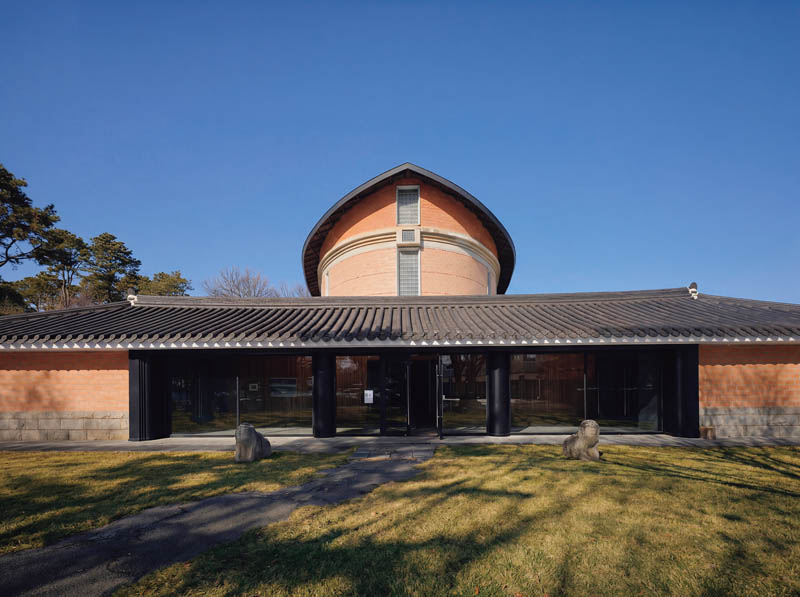
Located beneath the main building, the Gujeong Art Center (1982) is architect Itami Jun’s first project in Korea. Organized around a central hall flanked by two galleries, the space hosts various cultural events and special exhibitions.
The Onyang Folk Museum is regarded as an essential stop on any architectural pilgrimage in Korea. The main building was designed by architect Kim Seok Chul (1943–2016), a towering figure in modern Korean architecture known for landmarks such as the Seoul Arts Center and the Korean Pavilion built for the 46th Venice Biennale in 1995. Imposing yet in harmony with its surroundings, the building offers a modern reinterpretation of traditional elements, such as long overhanging eaves and numaru, elevated wooden-floor balconies found in traditional houses. While these features provide structural stability, the red and black brickwork is laid in alternating horizontal and vertical sections across both the exterior and interior walls. The design draws inspiration from the bricklaying techniques and color scheme found inside the Tomb of King Muryeong (r. 501–523), a royal burial site from the ancient Baekje Kingdom (18 BCE–660 CE).
The main building houses three permanent exhibition galleries and a special exhibition hall, displaying some ten thousand artifacts that offer glimpses into the lives of Korean ancestors. Gallery 1 explores the Korean life cycle through rites of passage — coming of age, marriage, funerals, and ancestral rites — alongside the essentials of food, clothing, and shelter. Gallery 2 is devoted to traditional livelihoods, including farming, fishing, and hunting and gathering. Gallery 3 covers various folk crafts, popular beliefs, traditional games, scholarship, and social systems. The carefully planned layout and circulation of each gallery draw visitors deeper into the exhibition. This immersive experience stems from a design process initiated at the architectural planning stage, incorporating precise calculations of each artifact’s scale and placement in relation to the viewer.
Gallery 1 recreates traditional domestic spaces such as the kitchen, inner quarters (anbang), wooden-floored hall (daecheong), and men’s quarters (sarangbang). Here, external light is minimized to evoke the atmosphere of the past. By contrast, Gallery 2 invites natural light through upper windows, heightening the immediacy of the everyday tools on display. In the central hall, sunlight filtering through high windows beneath a lofty ceiling creates an atmosphere that changes from day to day.
The Onyang Folk Museum boasts yet another architectural gem: the Gujeong Art Center, which takes its name from the museum’s founder, who used the pen name Gujeong. Completed in 1982, it was the first project in Korea by internationally renowned Korean-Japanese architect Itami Jun (1937–2011). Itami was named a Chevalier of the Order of Arts and Letters and awarded the Legion of Honor by France in 2005, before collecting Japan’s prestigious Murano Togo Prize in 2010. His most famous works include the Podo Hotel, Biotopia Museum, and Bangju Church on Jeju Island. Deeply engaged with Korean culture, he studied the stone-rich terrain prior to designing the building. He used local stone for the walls and worked alongside residents to produce bricks from high-quality local clay. To reflect Asan’s identity as Admiral Yi Sun-sin’s childhood home and final resting place, the structure was conceived in the form of the admiral’s iconic Turtle Ship (Geobukseon). Even from a distance, the building’s distinctive curved roof is immediately recognizable.
Step inside Gujeong Art Center’s central hall and it becomes clear that the structure itself is a work of art. White surfaces blend with earthen bricks, while two massive columns command the open space. The ceiling, rising more than 11 meters overhead, with crisscrossing wooden beams, evokes the sensation of standing inside a cavernous wooden vessel.
FROM HERITAGE TO HOT SPOT
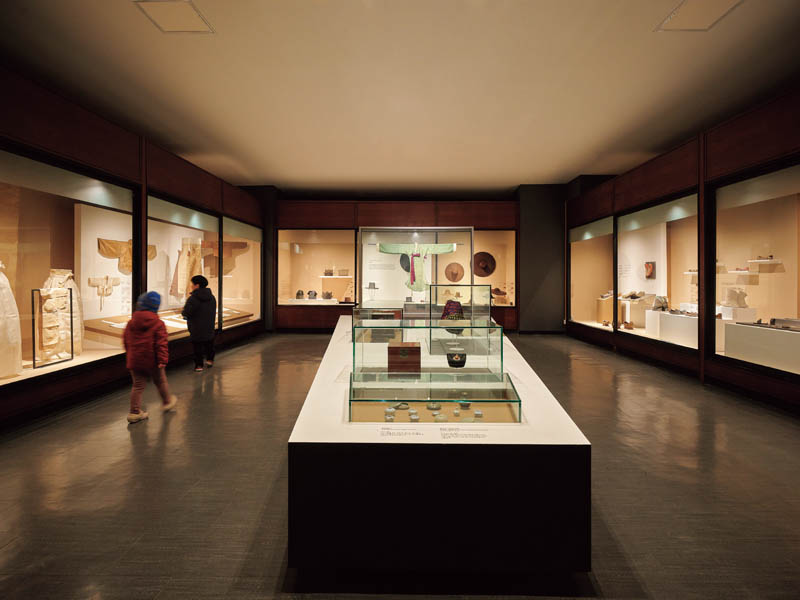
The first gallery greets visitors with artifacts related to food, clothing, and shelter, thoughtfully arranged by stages of the human life cycle.
When it first opened, the Onyang Folk Museum drew lines of visitors outside the door. After a period of stagnation, the museum regained momentum in 2013, following the renovation and reopening of the Gujeong Art Center as a multipurpose venue for performances, exhibitions, and public events. The change picked up speed in 2022 with the establishment of the Asan Craft Center and the opening of Café Onyang — moves that have drawn a noticeably younger crowd.
As a private institution that relies heavily on subsidies and donations, one of the museum’s most pressing challenges is raising its profile and attracting visitors. A recent boost has come from its merchandise brand, Objet Onyang. Traditional mask magnets, developed in collaboration with local artists, have proven so popular they are now sold at the House of Shinsegae in downtown Seoul. Hands-on kits for traditional toys, such as spinning tops and kites, have also been popular with families.
Looking ahead, the museum is digitizing archives accumulated since its early days to support systematic research and subsequent exhibitions. In January, Director Kim Eun-kyung — the youngest of the founder’s five children — received a presidential commendation for her contributions to the institution’s restoration and development.
As it approaches its 50th anniversary in 2028, the Onyang Folk Museum is preparing special exhibitions and publications to mark the milestone. Recently, the Gujeong Art Center attracted new attention when it made an appearance in the Netflix original series Can This Love Be Translated?, resulting in a noticeable rise in international visitors. Now, traditions of the past are finding new life as the trends of today.
 한국국제교류재단