Hanji has moved beyond its role as a traditional material to become a vital medium for contemporary artistic experimentation. For artists seeking to articulate their distinctly Korean identity, hanji offered an essential methodology for realizing artistic philosophies that are not based on Western frameworks. With a history spanning a thousand years, it continues to command attention as an expressive language that affirms the contemporaneity of Korean art in an era marked by rapidly shifting aesthetic sensibilities and artistic values.
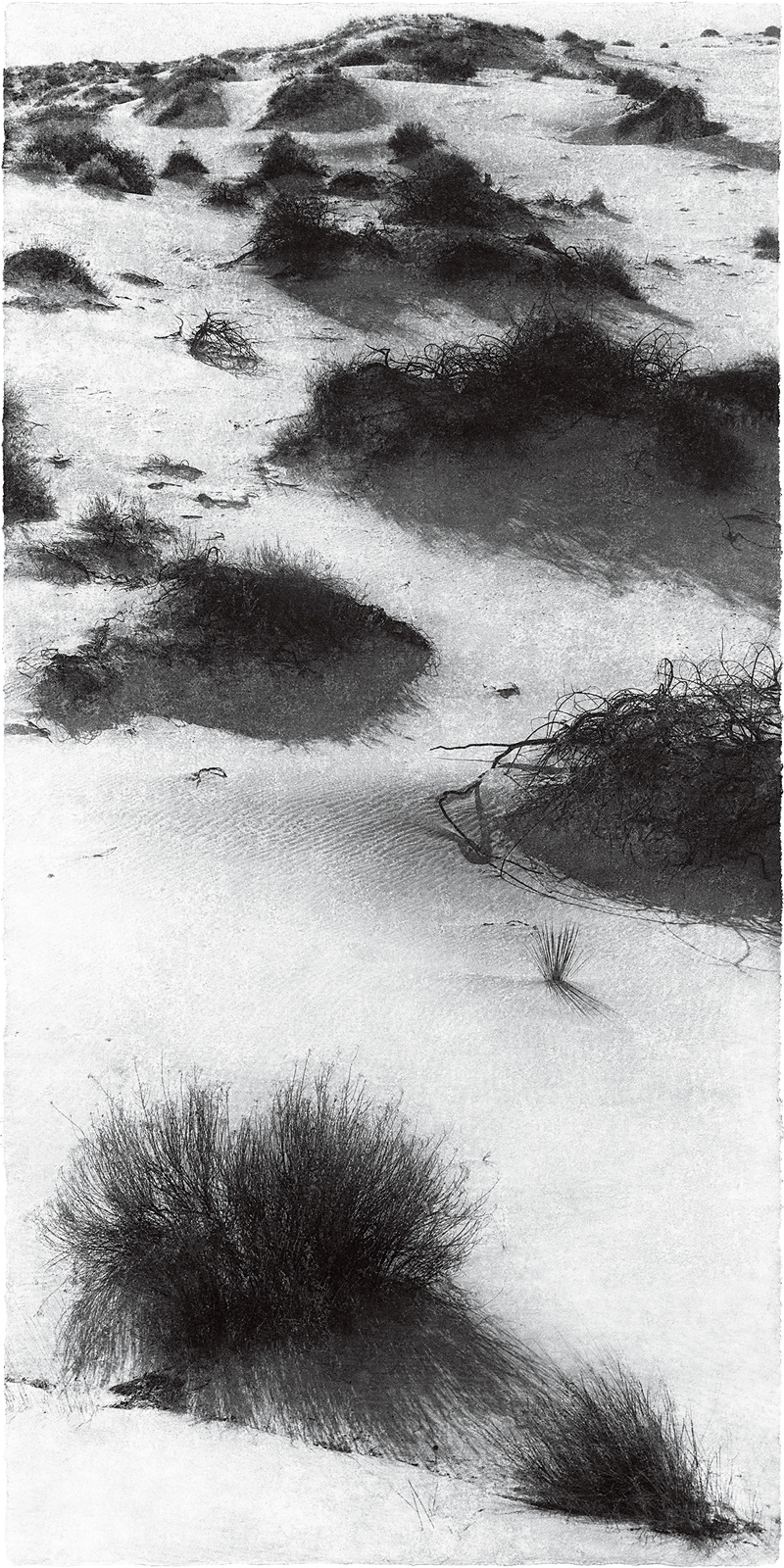
“Opening 21.” Jungjin Lee. 2016. Archival pigment print on hanji. 145.5 × 76.5 cm. ed. 10+3AP.
Courtesy of the artist and PKM Gallery
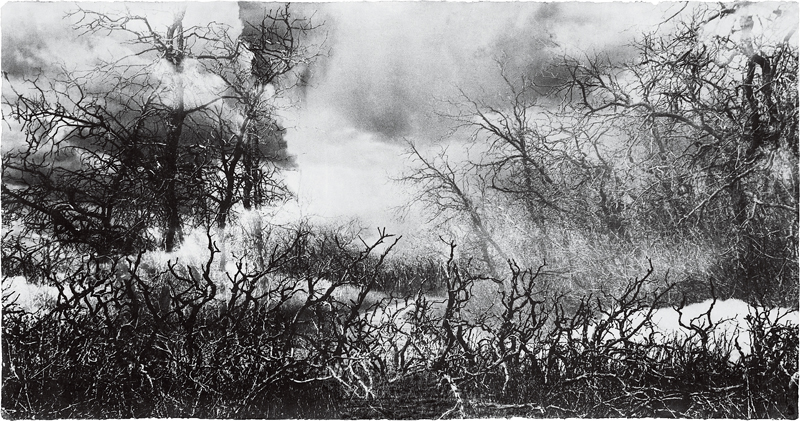
“Wind 07-95.” Jungjin Lee. 2007. Photograph on hand-coated hanji. 75.5 × 144.5 cm.
Courtesy of the artist and PKM Gallery
The active incorporation of traditional paper into contemporary Korean art is hardly a recent development. One need only consider Dansaekhwa, the monochrome movement that marked the global rise of Korean art. For these artists, hanji was far more than a traditional material; it was a medium that embodied the raison d’être of their work. Whereas, traditionally, the Western canvas largely serves a supporting role — receiving and sustaining paint as the primary material — hanji assumes a far more autonomous presence in Dansaekhwa. In Park Seo-Bo’s renowned “Écriture” series, for instance, the artist’s physicality and mental discipline are inscribed through the repeated act of pressing lines or grooves into wet paper. Similarly, Kwon Young-Woo tore and pierced the surface of the paper, transforming its physical presence to expand the very definition of painting.
Layered with human labor, time, history, and memory, hanji continues to be reinterpreted bycontemporary artists as something that exceeds mere materiality. It has emerged not onlyas an innovative formal language and a site for diverse experimentation but also as a medium of discipline,contemplation, and inspiration. At the intersection of form and thought, hanji acquires new meaning througheach artist’s distinctive approach. In this process, the boundaries between photography, painting, and sculpturebegin to dissolve, broadening the spectrum of artistic expression and allowing past and present to resonate with one another.
DEPTH OF IMMERSION
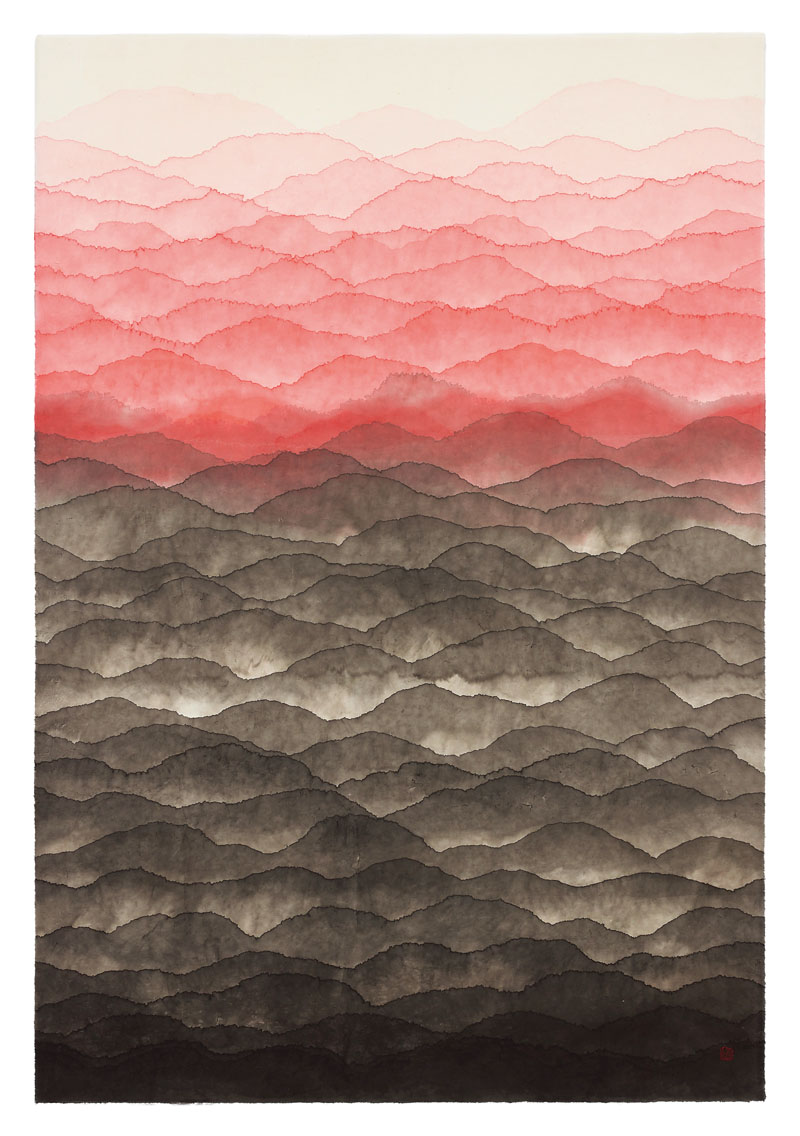
“Mountain.” Minjung Kim. 2022. Ink and watercolor on hanji. 189 × 130 cm.
Courtesy of the artist
For more than three decades, the New York-based photographer Jungjin Lee has captured landscapes that elude photography’s conventional function as a medium of representation or documentation. From the vast deserts of the North American continent and the elemental forms of earth and rock to Korea’s ancient stone pagodas and even everyday objects such as postage stamps, Lee’s images — reminiscent of ink wash paintings — convey a poetic sensibility shaped by emotion and intuition.
The power of her photographs, now recognized worldwide and held in the collection of the Metropolitan Museum of Art in New York, among others, is heightened through analog prints rooted in hanji. In the late 1980s, the artist developed a distinctive method of brushing photosensitive emulsion onto the surface of traditional hanji and then printing the image directly onto it. This handcrafted process — that may rightly be described as artisanal — redefined the traditionally reproducible nature of photography, foregrounding instead its materiality, painterly qualities, and temporality. Imbued with the characteristically coarse texture of hanji, the images engage not only the eye but also the sense of touch. This quality remains palpable even in the artist’s more recent works, which combine analog printing with digital techniques.
Lee’s photographs feel less like landscapes of this world and more like intimate portraits. This effect is heightened by her use of hanji, whose rough, hand-torn edges are preserved as an integral part of the works. Her intention to allow the images to “breathe” lends the black-and-white photographs a quiet depth, enabling them to transcend time and space and assert a timeless presence. As a result, Lee’s images feel liberated; rather than being confined and fossilized within a frame, they radiate an expansive freedom that seems to extend infinitely outward. For Lee, hanji serves not only as a conduit through which viewers can viscerally experience her sensations and perceptions but also as a vital collaborator — one that overcomes the limitations of photography and deepens the viewer’s immersion.
OBJECT OF CONTEMPLATION
While hanji symbolizes the breath of life for Jungjin Lee, for calligraphist and painter Minjung Kim it becomes a medium of contemplation. In her serene studio in Saint-Paul-de-Vence in southeastern France, she draws upon the traditions of East Asian calligraphy, ink wash painting, and Eastern philosophy, translating them onto hanji. Kim regards hanji as an independent entity, both fragile and resilient, capable of withstanding the passage of time.
Since the early 2000s, Kim has employed a meticulous process of cutting and layering hanji to create form. By singeing the edges of the paper with candles or incense sticks, she produces organic, spontaneous effects reminiscent of the natural bleeding of ink or watercolors. This uncontrollable collaboration between the paper and nature (fire) gives rise to ethereal landscapes that defy artificial reproduction. Under the artist’s fingertips, fragments of hanji shift in color, shape, and texture, culminating in a novel approach to abstraction with subtle dimensionality. Her style is defined by an experimental approach that dissolves boundaries — between Eastern artistic sensibilities and Western abstract visual language, and between painting and sculpture.
To Kim, hanji is more than just a familiar everyday material; it is an ontological object as intimate as her own skin. It is also a stage where the meditative practices of patience, restraint, and the cyclical principles of Zen and Dao take visible form. As she burns the paper, she steadies her breath in a meditative rhythm, spending hours delicately layering the fragments gained through such intense concentration. Her work emerges only through destruction and is made complete by the act of emptying. When these reflections, having permeated layers of hanji, are finally sublimated into art, viewers experience a profound sense of healing.
MEMORIES OF TIME
For Chun Kwang Young, hanji is a medium of memory. At the heart of his artistic world lies a scene from his childhood: his uncle, a practitioner of traditional medicine, meticulously wrapping medicinal herbs in hanji. Chun reimagines this memory by wrapping triangular pieces of Styrofoam in pages torn from old books, binding them with string to mimic the form of traditional herbal medicine parcels. These fragments — resembling small gifts wrapped in bojagi, cloths traditionally used to wrap, store, or carry items — serve as the fundamental units and primary visual language of his work.
Thousands, sometimes tens of thousands, of these parcels are meticulously affixed to panels to form “Aggregation,” Chun’s most celebrated and defining series. The irregularly protruding units lend the relief-like surface a breathing, rhythmic vitality. The artist eventually expanded his scope further, creating monumental sculptures that amplify this organic movement. Exhibited in Venice and around the world, his works blur the boundary between two- and three-dimensional space, intuitively giving form to his declared desire to “contain the soul and spirit of the Korean people.”
Chun’s primary materials — old books and their faded hanji pages — carry the collective memories of past generations. Traces of printed characters and markers of time embedded in his work preserve the essence of their daily lives, history, and scholarly records. These hanji-clad fragments collide or achieve a powerful harmony, forming a new visual order. At times, they offer a critique of the modern world; at other times, they convey hope through vibrant hues derived from natural dyes. In Chun’s hands, hanji honors its origins while embodying profound sentiments, holding within it stories that seem to surpass imagination.
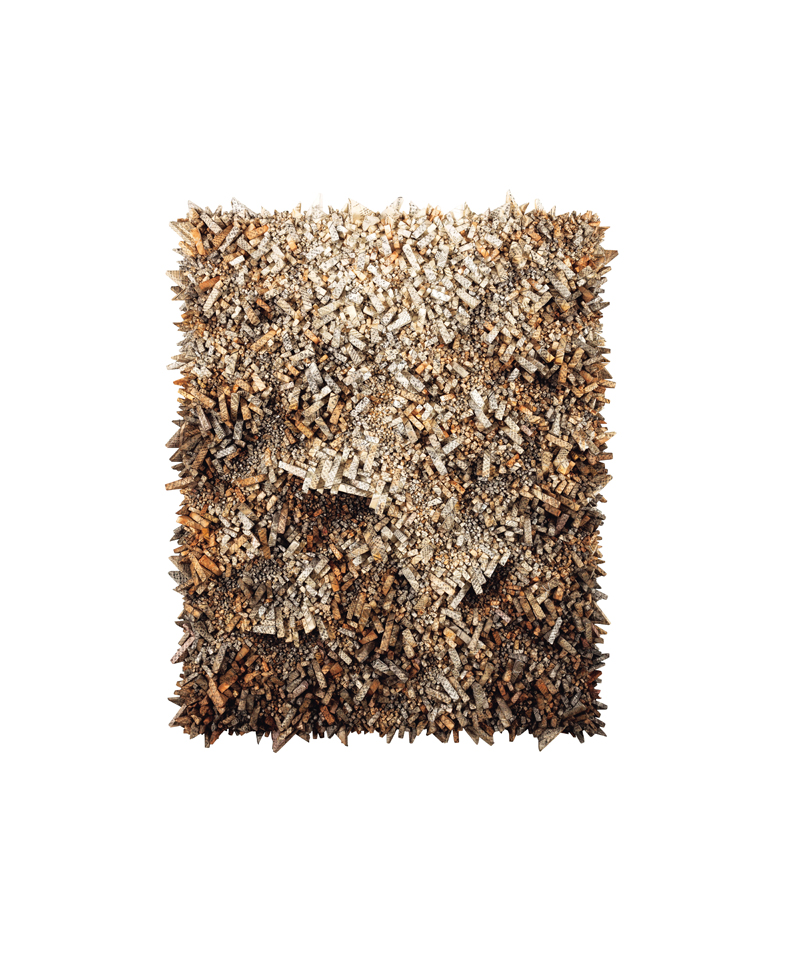
“Aggregation 13-MA008.” Chun Kwang Young. 2013. Mixed media with hanji. 250 × 200 cm.
© Chun Kwang Young & CKY Studio
RESONANCE OF MATERIAL AND SPIRIT
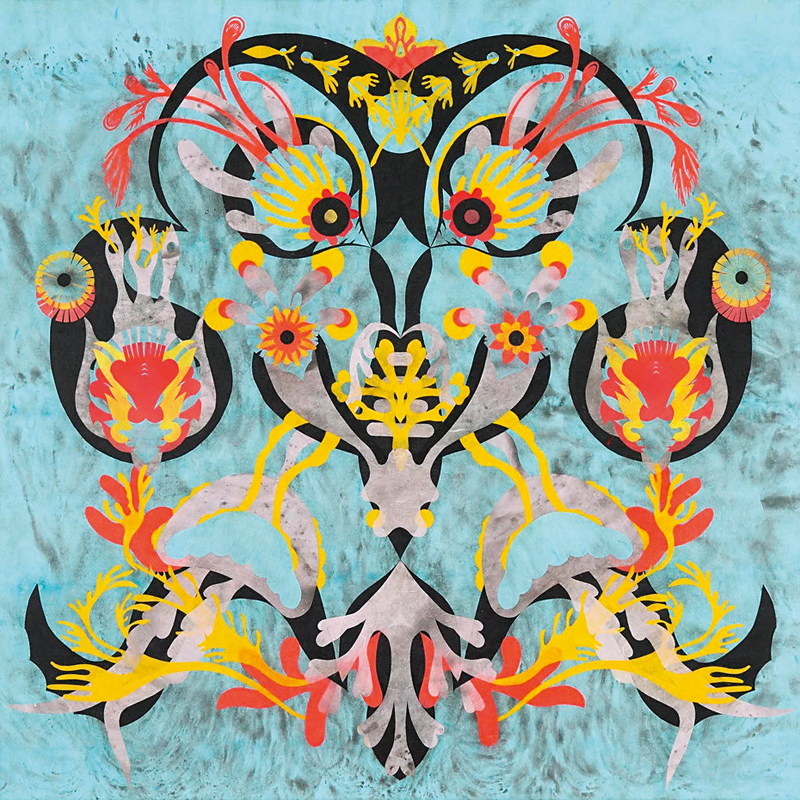
“Splashing Volcano Ash Gaze – Mesmerizing Mesh #140.” Haegue Yang. 2022.
Hanji on Alu-Dibond, framed. 62 × 62 cm.
Courtesy of the artist, Photo by Studio Haegue Yang
In the work of sculptor and installation artist Haegue Yang, hanji serves as a thread linking human civilizations. Throughout her career, she has explored the intricate relationship between materiality and spirituality. “Mesmerizing Mesh,” a series she has pursued since 2020, centers on collage-based works rooted in her research into paper ritual implements used in shamanic tradition. For these rituals, hanji is folded and cut in specific ways to create neokjeon (literally “soul sheets”), which are intended to house the spirits of the deceased. The belief that paper objects symbolize the interplay between the material and the spiritual is not unique to Korea. Sacred paper objects associated with shamanic, folk, or pagan traditions have been handed down for generations across cultures, crafted from materials such as hanji, Japanese washi, and Chinese chupizhi (mulberry bark paper). In “Mesmerizing Mesh,” Yang channels the spiritual resonance of paper found in these diverse cultures into a contemporary artistic language.
Although Yang is primarily known for her sculptures and installations, she has long maintained an affinity for two-dimensional formats. Engaging with flatness is for her an act of folding, cutting, gluing, and layering materials. “Mesmerizing Mesh” likewise builds abstract layers and overlapping surfaces through a variety of motifs and decorative elements, extending the artist’s earlier methods of transforming materials such as venetian blinds, artificial straw, and bells. Whereas her sculptures and installations shape physical space, these two-dimensional works — produced by “flattening” — paradoxically contain even denser and more varied strata. Folded and compressed, “Mesmerizing Mesh” enters a realm of abstraction that transcends the dichotomy of flatness and volume. For both the artist and the viewers, the paper itself — specifically hanji — is the gateway and the key to this world.
 한국국제교류재단