Lee Jung-seob (aka Yi Chung-sop) is undoubtedly the most widely beloved Korean artist ofthe 20th century. Most of his works have been scattered among private collections since the“Lee Jung-seob boom” of the 1970s, making it difficult for researchers and the general publicto view his complete body of work in a single setting. The “100th Anniversary of the Birth ofKorean Modern Masters: Lee Jung-seob 1916–1956,” organized by the National Museum ofModern and Contemporary Art, is the first large-scale retrospective of Lee’s work.
“Family on the Road” (1954).Oil on paper, 29.5 x 64.5 cm.A family sets out on a journeyat dawn. The sun has not fullyrisen, so it’s still dark. Thepainting conveys the artist’shope of reuniting with hisfamily one day.
Like the hero of a popular novel ormovie, Lee Jung-seob is muchbeloved by the Korean public. Thedramatic story of his short life — markedby artistic genius, tragic longing for lovedones, drifting from place to place, and anuntimely death — has become legend.From his birth in 1916 until his lonely deathin 1956 at the age of 40, Lee led a humblelife, which was joyful at times. It was onlyafter his death that he rose to fame as amaster of Korean contemporary art.
Choi Yeol, an art historian and author ofthe book “Lee Jung-seob, a Critical Biography:Searching for the Truth Behind theArtist’s Myth” (2014), gives his take on whyLee has become an artist so adored by theKorean people: “Having suffered the devastatingconsequences of the Korean War,what the people needed was a pure soulwho could help them endure the bleaktimes, and the person who best fit the billwas Lee Jung-seob. Brought to life as apure soul with explosive talent, Lee becamea symbol of integrity.”
Records of a Wandering Soul
Lee was born in Pyongwon County,South Pyongan Province (in present-dayNorth Korea). He spent his life wanderingfrom place to place, living in more than 10cities, including Pyongyang, Tokyo, Seogwipo,Busan, Tongyeong, and Seoul. Melancholyand a yearning for love permeatehis paintings, as well as a sense of emptinessand innocence, perhaps becausethey are records of a wandering soul. Leewas widely acquainted with writers, andthese encounters also imbued him with apoetic spirit that enabled him to overcomethe hardships of a nomadic life. Lee usedto say, “Art is a record of the power of truthconquering the storm.”
The Lee Jung-seob retrospective runsfrom June 3 to October 3 this year at theDeoksugung branch of the National Museumof Modern and Contemporary Art. Itshowcases some 200 works and 100 materialson loan from 60 institutions includingthe Museum of Modern Art in New York,providing a comprehensive picture of theartist’s life and career. A rich array of hisworks are on display, including 60 of hismost important oil paintings, such as “Bull”and “Family on the Road,” tinfoil paintings,drawings, postcard and letter illustrations,and various personal items. The illustrationson the postcards and letters that hewrote to his family, from whom he livedapart due to the war and his state of abjectpoverty, convey a heartrending family historyand, in a larger sense, the tragic historyof separation shared by numerous Koreans.
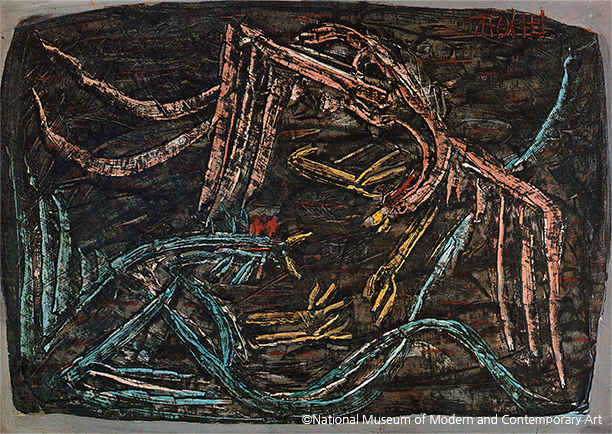
“Cockfighting” (1955). Oil on paper, 28.5 x 40.5 cm.Two cocks fighting divide the canvas diagonally. Lee first painted the basic shapes in thethree primary colors, then painted them over in dark gray, and scratched the surfacewith a chisel in swift, sweeping strokes before the paint dried.
Lee’s most prolific period was five yearsduring the 1950s — a stunning testimonyto the artist’s irrepressible creative passion in the face of destitution and hardshipin the war’s aftermath. During the last yearof his life, he battled anorexia, mental illness,and hepatitis, and yet he never putdown his brush. Even when death was near,his determination never faltered as he heldonto the hope of reuniting with his wife andtwo sons in Japan. A passage from a letterhe wrote to his wife in 1954 gives us aglimpse into his heart:
“An artist who is not able to give hiseverything to become one with his preciousand beloved wife cannot hope tomake good art. There are those whoproduce artworks without being married,but Agori [his nickname, meaning“long-jawed Lee”] is not that kindof artist. I am seeing myself from theright perspective. Art is a never-endingof love. When you arefilled with true love, your heart is able toreach a pure, clean state. Please havefaith in the great artist Jung-seob, whothinks only of you when painting, andstay happy and healthy, maintaining thegreatest self-respect and spirit in all ofTokyo.”
Lee liked to call himself an “honestpainter.” Honesty in his feelings is revealedin the depiction of children that appear inmany of his works. He projected himselfinto the images of young boys, perhaps as away to escape his harsh reality.
Creation of Tinfoil Paintings
Probably the most discussed amongLee’s works are his tinfoil paintings. Leewas an avid smoker, but more importantthan the cigarettes was the tinfoil lining inthe cigarette packs. Lacking the money topurchase art materials, he used the tinfoilas a canvas. Most of his tinfoil paintingswere produced during his years in Busan,where he sought refuge after the war brokeout. This was a new genre that Lee hadinvented using an innovative and unprecedentedtechnique. The paintings were producedby scratching images on the surfaceof a silver foil lining, applying paint, andthen wiping away the excess paint, leaving paint in only the etched recesses. The endproduct was a drawing composed of etchedlines that were rendered on a flat surfacebut created the illusion of being indented orraised, with a glittery surface heighteningits artistic appeal.
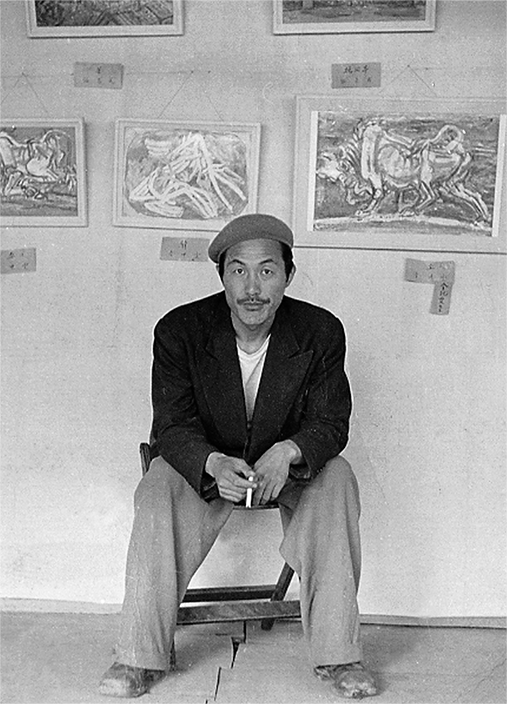
Lee Jung-seob poses at an exhibition held jointly with three other artists in the southernport city of Tongyeong in 1954, shortly after the Korean War ended.
Lee is known to have produced some300 tinfoil paintings; they are small in size,measuring only 9cm x 15cm, and are filledcompletely with images. The drawings capturethe essence of the subject in just a fewlines that express key features. Images ofnaked children are frequently found in histinfoil paintings, rendered in distinct, boldlines that obviously express his desperatelonging for his family. Lee used to say thatthese paintings were rough sketches formurals he wanted to paint later.
The main theme that runs throughoutLee’s work is his love for his wife and twosons. This is also why his paintings havesuch broad appeal and are loved by peopleof all ages. Lee met his wife, MasakoYamamoto (Korean name Lee Nam-deok),when he was studying art at Bunka Gakuinin Tokyo. He pursued her ardently, sendingher about 90 postcards to express his loveuntil he finally won her heart. Illustrationslike “In Mythology” and “Man and Woman”appearing on one side of a postcard seemfantastical and surreal, exuding great energy,and like the tinfoil paintings, constitutingan independent genre.
Lee sent his wife and sons to Japan in1952 in the midst of the Korean War, andthereafter led a solitary life, drifting fromplace to place, never forgetting to writeto them all the while. His 70 or so letters,making up some 150 pages, featuredelightful illustrations that overflow withlove and yearning for his family. The lettersare not only a valuable resource for studyingthe relationship between Lee’s life andhis art, but are also works of art in themselves,marked by the harmony of unrestrainedhandwriting and impromptu drawings.“I will do my best to paint as quickly asI can in order to hold an exhibition and sellmy paintings. Then I’ll be able to visit you,bringing lots of money and presents. Soplease stay healthy until then,” he pleads inone of his letters.
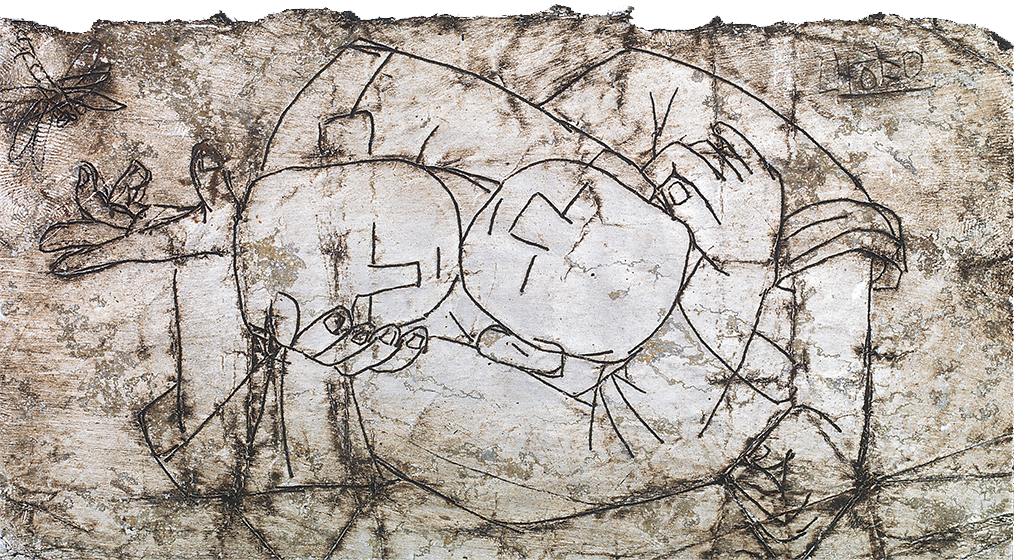
“Two Children” (1950s). Etched on tinfoil, 8.5 x 15.5 cm.Lee Jung-seob created his tinfoil paintings using an innovative method that is reminiscentof the inlaying technique of Goryeo celadon or silver inlay on metalware.
Boundless Experimentation
It appears that Lee did not care muchabout what materials he used. Wheneverdeeply immersed in his work, hedidn’t hesitate to experiment with whatevermaterials were on hand. Accordingto the latest study completed this pastApril, among his 540 or so surviving works,around 140 are oil paintings and about 160are colored drawings.
The retrospective features five of Lee’strademark bull paintings. The bull was hisalter ego and the spirit that exemplified his work. He had a predilection for white bulls,considering them a symbol of the “whiteclad”Korean people and their patience andtenacity to overcome hardship. In one work,a thin and bony-looking bull takes a massivestride, stomps on the ground, and continuesits march resolutely. One can feel anintense energy emanating from Lee’s boldbrushwork, which captures the bull’s powerfulimage in just a few strokes.
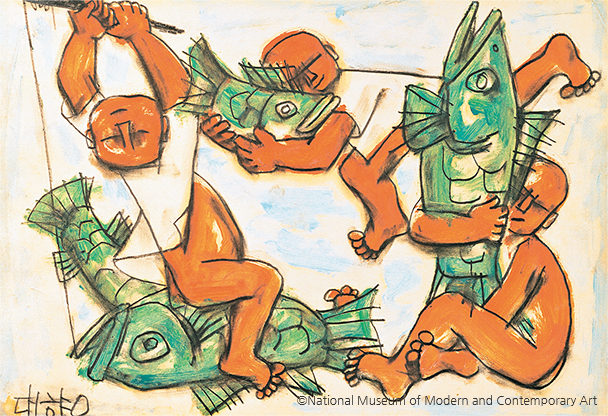
“Three Children with Fish” (1950s). Oil on paper,27 x 36.4 cm.
The most representative of Lee’s bullpaintings is an oil painting producedbetween 1953 and 1954, a close-up of thehuge head of a bellowing red bull, with thered sunset in the background. The realisticdepiction of the big eyes and wide openmouth letting out a ferocious roar, as wellas wrinkles on its sunken cheeks, is trulystaggering. Choi Yeol explains the significanceof the bull in Lee’s paintings:
“Lee was a purist who pursued the fantasticaland mystical during his youth when he was well-off, but the experienceof the war changed him. He turnedhis eyes to the world and became morein tune with the spirit of the times. Hecame to believe humanism that standsup against mass killing, immorality, andpoverty should be the foremost humanvalue, and discovered this value in theworld and the family. His ‘Bull’ series,painted during the 1950s, was a productof the times that reflected the history ofa nation as well as his personal history.”
Images of naked children are frequently found in his tinfoil paintings, rendered in distinct, bold linesthat obviously express Lee’s desperate longing for his family. Lee used to say that these paintings wererough sketches for the murals he wanted to paint later.
Enduring Legend
On September 6, 1956, Lee died at SeoulRed Cross Hospital in Seodaemun-gu, centralSeoul. With no family members present,his body was left at the hospital forfour days until a friend came. In contrast tohis tragic life, his posthumous exhibitionsgarnered huge attention and attracted anoverflow of visitors. The 30th anniversaryspecial exhibition, held in June 1986 at theHo-Am Art Gallery, Seoul, had to be extendedto accommodate the large crowds. Itdrew an impressive 100,000 visitors, alltold. Another special exhibition held in January1999 at Gallery Hyundai also attracteda similar number of visitors.
“Bull” (1953-54). Oil on paper, 32.3 x 49.5 cm.Among the “Bull” series by Lee Jung-seob, thispainting is considered the most striking.
Poet Ku Sang (1919–2004), a lifelongfriend of Lee’s who had always been byhis side, left these words in his memory:“I don’t know of any artist who, like Jungseob,showed such consistency betweenhis art and person, between his art and thetruth. He was kind and compassionate toall those he knew, and lavished deep affectionon animals, birds, fish, and even treesand grass, depicting their harmoniouscommunion with fresh, energetic brushstrokes.”
These words help to explain why researchand evaluation of the artist Lee Jung-seoband his works are still ongoing.
Chung Jae-sukEditorial Writer and Senior Culture Reporter, The JoongAng Ilbo
 한국국제교류재단