Lee Daiwon, a prominent figure in modern and contemporary Korean art, was renowned for his rustic pastoral landscapes rendered in vivid colors and buoyant brushwork. Rather than chasing the Western art trends of his day, he devoted decades to studying the formal principles of traditional Korean crafts and East Asian ink painting, translating these visual idioms into oil on canvas.
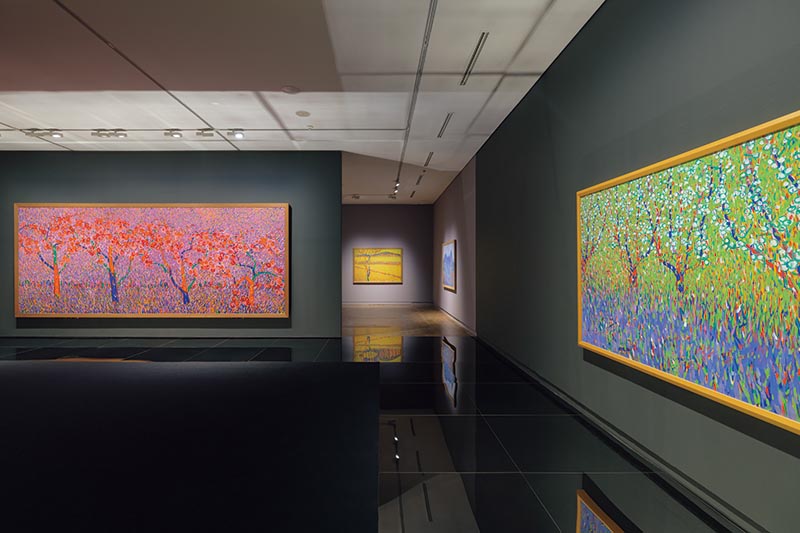
Held at MMCA Deoksugung, Lee Daiwon: Nothing Here Makes You Sad is the museum’s first major retrospective of the artist Lee Daiwon, offering a comprehensive overview of his artistic career and practice.
Courtesy of the National Museum of Modern and Contemporary Art, Korea
WHEN STANDING BEFORE the works of Lee Daiwon (1921–2005), viewers immediately notice the color. Trees seemingly clad in a saekdong jeogori (a traditional Korean jacket with rainbow-colored stripes), azure ponds, and luminous yellow fields fill the canvas. Step closer, and the scenery fragments into countless dots and brisk strokes of unmixed red, blue, yellow, and green, each shimmering brightly across the surface.
For decades, Lee Daiwon was known as the “orchard painter,” also nicknamed “the happiest painter in the world.” He studied law at Keijo Imperial University (the predecessor to present-day Seoul National University), once managed the Bando Gallery, and later served as dean of the College of Fine Arts and president of Hongik University, as well as president of the National Academy of Arts, Republic of Korea. His radiant paintings and distinguished career seem to go hand in hand. Yet a fundamental question lingers: Why are his paintings so luminous? Where do these colors come from? Can this be credited solely to the artist’s innate optimism?
A GIFTED YOUNG STUDENT
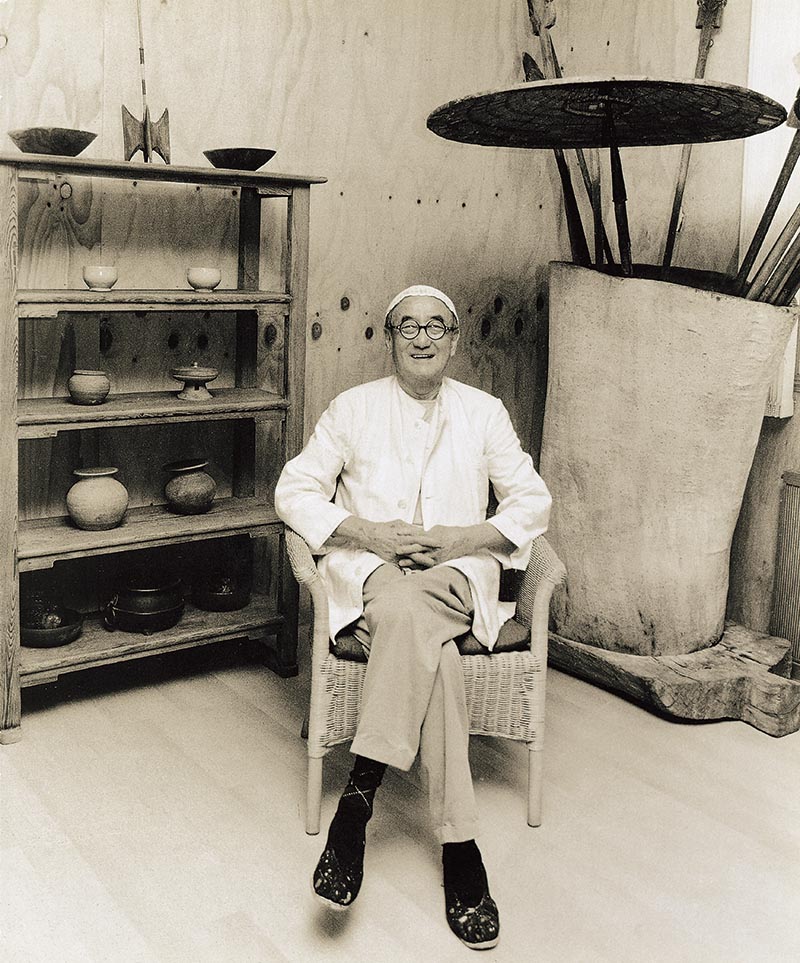
Lee Daiwon is an artist who developed a distinctive painterly language through dots and lines. Throughout his life, he reinterpreted the colors of traditional Korean crafts and the techniques of East Asian painting, exploring the possibilities of a Korean modern painting.
Courtesy of the National Museum of Modern and Contemporary Art, Korea
Though widely regarded as a self-taught painter, Lee Daiwon embarked on his creative path remarkably early. In 1933, at just 13 years old, he won recognition in a nationwide student art competition. Among his formative influences was Sato Kunio (1897–1945), his art teacher at Keijo Second Higher Common School (now Kyungbock High School in Seoul’s Jongno District). In his classes, Sato introduced modern Western art movements like Fauvism and the work of Pablo Picasso, while instilling a deep appreciation for the unique beauty of traditional Korean crafts. That very classroom nurtured several other leading figures of modern Korean art, including Yoo Youngkuk (1916–2002), Chang Ucchin (1917–1990), and Kwon Ok-yeon (1923–2011).
In 1938, at age 18, Lee submitted two works for the Joseon Art Exhibition, both of which were selected. He submitted an oil painting for the Western Painting section and a folding screen in the Crafts section, the latter created using the naphil (batik) technique which is a traditional resist-dyeing method where beeswax blocks out designs before the fabric is dyed. For a single student to have works selected in both the fine art and crafts sections in the same year was exceptional, underscoring that his creative roots were never limited solely to the canvas.
TRADITIONAL AESTHETICS AND EXPRESSIVE PRINCIPLES
At first glance, Lee’s canvases readily evoke Georges Seurat’s pointillist technique or Vincent van Gogh’s vigorous brushwork. But was his pictorial language truly shaped by the tenets of Western modern art?
In 1957, with the support of The Asia Foundation, Lee toured major museums across the United States and Europe and held a solo exhibition in Germany. Upon returning home, he had no interest in simply mimicking Western movements. Instead, he began to reflect more deeply on the essence of Korean beauty. Over the years, he amassed an extensive collection of Joseon-era (1392–1910) crafts — including traditional wooden tables used for carrying or serving food called soban (literally “small table”), wooden ware, and bandaji (hinged drop-front chest) — while taking a keen interest in traditional artisanal techniques such as jasu (embroidery) and najeon (mother-of-pearl inlay). In 1989, he published an illustrated essay collection, Fifty Years in Hyehwa-dong, in which he articulated his artistic philosophy:
“What I truly cherish are Joseon crafts. The exquisite, radiant colors of embroidery, imbued with the devoted care of Joseon women, never fail to inspire sheer awe. Yet there is one tendency we ought to reconsider: confining the idea of tradition solely to subject matter. While capturing traditional motifs is certainly one approach, what is far more fundamental is how we adapt and evolve the expressive modes, techniques, and aesthetic sensibilities refined by our predecessors for the modern era.”
This statement is the key to understanding his art. For 20th-century Korean painters, “What constitutes modern Korean art?” was an unavoidable question. Transplanting traditional ink landscapes, ceramics, or folk motifs directly onto the canvas was one way of seeking an answer. Rather than quoting the outward forms of tradition, however, Lee Daiwon focused on the way in which tradition gives form to an image. In embroidery, for instance, when red and blue threads sit side by side, they never blend; though touching, each preserves its distinct chromatic identity. The iridescence of najeon offered another clue for Lee; inlaid against a dark lacquer background, the mother-of-pearl reflects light off its surface rather than diffusing it into the surrounding air. Furthermore, through studying traditional landscape paintings called sansuhwa (“paintings of mountain and water”) and sagunja (“The Four Gentlemen”), he mastered the East Asian ink-wash techniques of rendering mountains and trees through dots and lines. Consequently, in Lee Daiwon’s oeuvre, “Koreanness” resides within the very technique of painting. Within his oil paintings, he revitalized centuries-old aesthetic sensibilities and expressive principles, allowing them to function anew on the modern canvas.
In this respect, his dots of color diverge fundamentally from Georges Seurat’s pointillism. Neo-Impressionist pointillism utilized the principle of placing different colors side by side, allowing the viewer’s eye to mix the colors. Lee’s dots, by contrast, maintain their distinct hues even from afar, retaining their distinct presence across multiple color layers. As the artist himself clarified, his method was never conceived with Western pointillism in mind. He once recalled that he first began applying dots while depicting mountain ridges, aiming to capture the tonal gradations and painterly vitality of ink wash (sumuk) through the medium of oil.
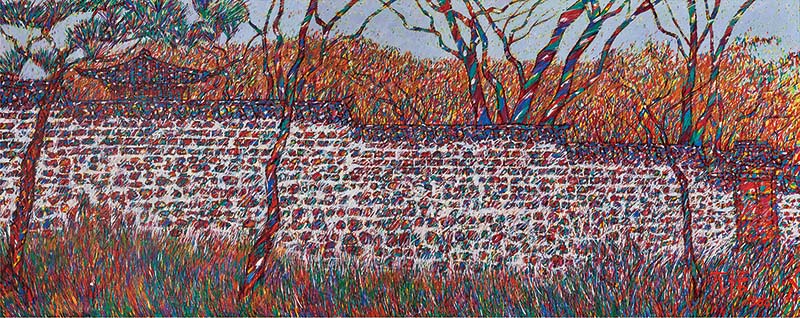
The Wall (Secret Garden ). 1986. Oil on canvas.
208 × 504 cm.
More than 5 meters wide, this monumental work exemplifies Lee’s distinctive sense of color, inspired by traditional embroidery and mother-of-pearl inlay.
Courtesy of the National Museum of Modern and Contemporary Art, Korea
SIMILAR YET DISTINCT LANDSCAPES
In the early 1970s, Lee Daiwon set up a studio at his family orchard in his hometown of Paju. For the next three decades until his passing, he returned to this single landscape again and again. Yet he was never merely replicating the same scene; with every shifting season and play of light, the orchard became a new composition.
In his orchard paintings from the 1970s, Western linear perspective remains relatively distinct: prominent trees anchor the foreground, guiding the viewer’s gaze toward distant hills. By the 1980s, spatial depth begins to compress, with blue and violet tonalities more prominent on the canvas. This evolution culminated in the 1990s, when distant mountains vanish altogether. Linear strokes of pure color depicting trees, ponds, and blossoms spread evenly across the canvas, markedly flattening the boundary between foreground and background.
The nature of his dots also evolved. While the color dots of the 1970s were placed along the contours of trees, hills, and fields in a relatively measured rhythm, through the 1980s they elongated into brisk, dynamic dashes that swept across the entire surface. Radiating in multiple directions, these strokes of color refuse to settle around a single focal point. Built up in thin, repeated layers, they distribute energy uniformly across the composition — a primary reason his late landscapes, despite their chromatic intensity, never feel dense or visually overbearing.
A compelling transformation followed: as spatial depth receded, the physical scale of the canvases expanded. Works produced from the 1990s onward frequently exceed two meters in width, spanning five or even seven meters across. Standing before these monumental compositions, viewers feel immersed inside the landscape rather than merely observing it from afar. Unbound by a single vanishing point, the gaze roams continuously — from tree to pond, and onward to blossoms and fields. East Asia has a long-standing tradition of experiencing landscape paintings in precisely this manner. Literati of the past would unroll depictions of renowned mountains inside their rooms to travel through them in mind and spirit — a practice known as wayu (“journeying while lying down”) or armchair traveling. In this tradition, a painting is not a window opening onto an external world, but a self-contained realm where the viewer can enter and wander freely.
Lee’s later orchard paintings progressively converged toward such a space. Archival photographs of Lee working at his Paju orchard reveal that rather than gazing down at the landscape from an elevated vantage point, he sat close to the earth among the trees, enveloped beneath a canopy of fruit boughs stretching in every direction. What he painted was not an orchard viewed from afar, but one experienced within his own mind and spirit. If a major trajectory of modern and contemporary Korean painting can be defined as a shift from traditional sansu (mountain-and-water landscape) to the Western concept of punggyeong (scenic landscape), in Lee’s late work, that trajectory is reversed. In rendering landscapes, he returned them to the experiential domain of sansu — a space for viewers to step inside and linger at will.
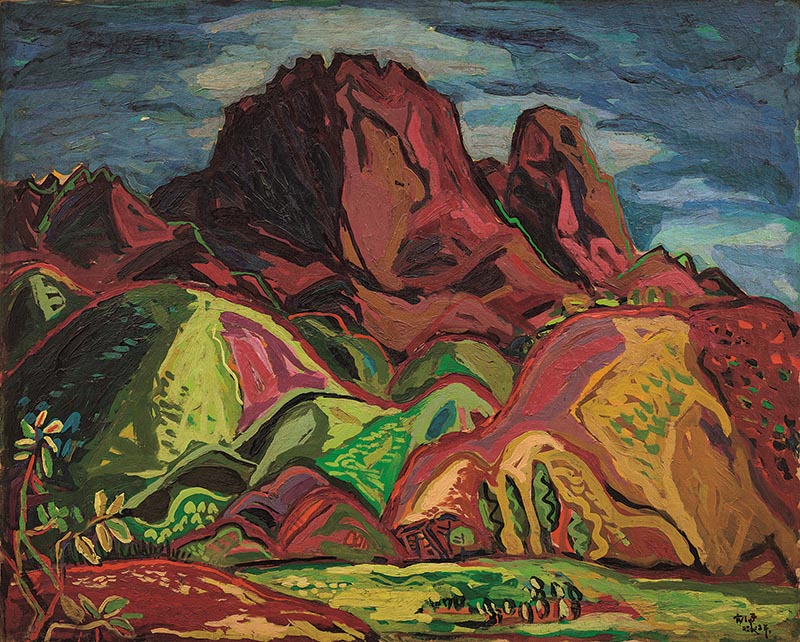
Bukhansan Mountain. 1938. Oil on canvas.
80 × 100 cm.
In this early work, part of the MMCA Lee Kun-hee Collection, Lee Daiwon captured his impressions of Mt. Bukhan in autumn through bold color contrasts.
Courtesy of the National Museum of Modern and Contemporary Art, Korea
CONTEMPLATING KOREANNESS
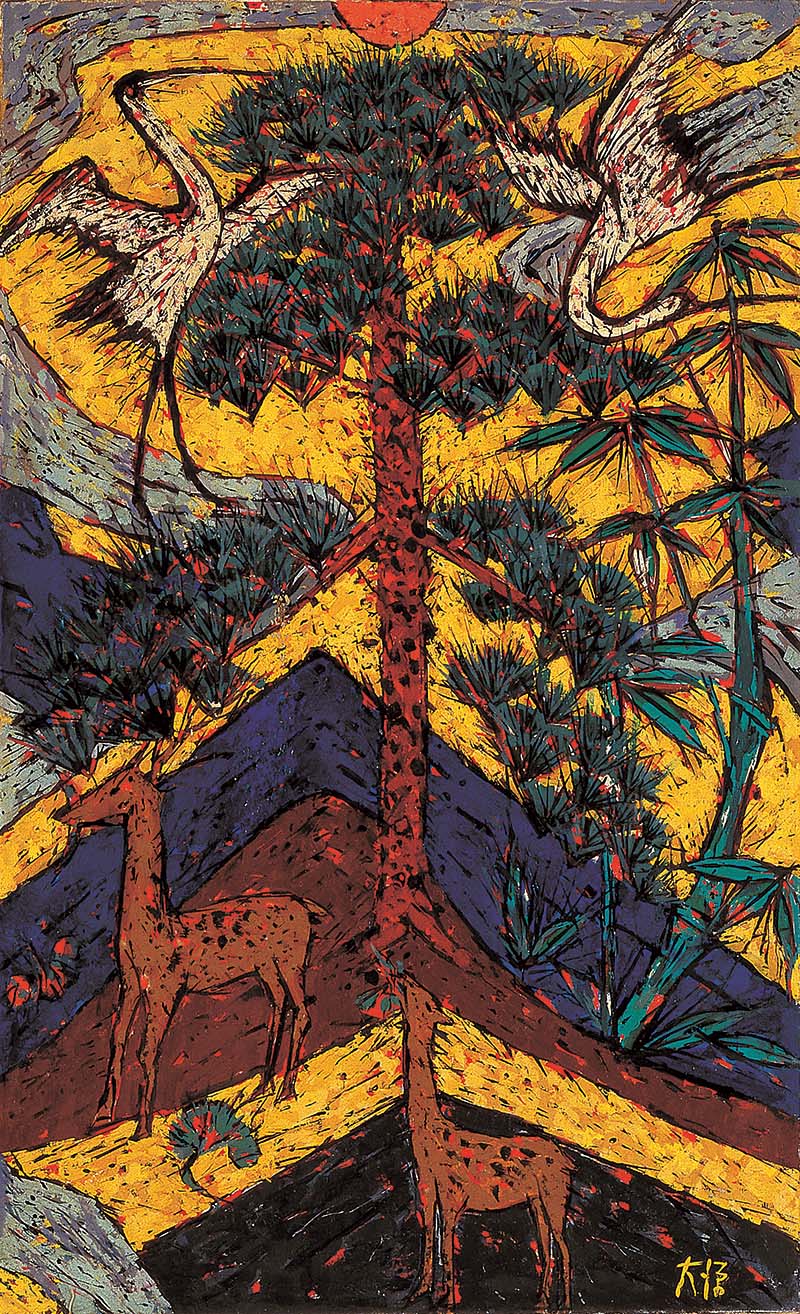
Village of Legends. 1964. Oil on canvas.
129 × 79 cm.
Reflecting Lee’s exploration of traditional painting and folk craft, motifs from traditional paintings of the ten longevity symbols, such as mountains, trees, deer and clouds, are juxtaposed across a flattened plane.
Courtesy of the National Museum of Modern and Contemporary Art, Korea
As contemporary Korean art garners growing global acclaim today, the fundamental question “What constitutes Koreanness?” resurfaces. Lee’s oeuvre demonstrates how contemporary Korean art can remain deeply rooted in tradition without replicating historical forms. Joseon embroidery or lacquerware does not make a literal appearance on his canvases, nor does he duplicate the mountains of traditional ink landscapes. Instead, he aligns pigments without blending them as seen in traditional embroidery, captures light on the painted surface like shimmering nacre, and layers dots and lines to depict nature as in a traditional Korean painting. Rather than borrowing the outward guise of tradition, he translates the very mechanisms through which tradition shapes the canvas into his own visual language.
At MMCA Deoksugung, a major retrospective titled Lee Daiwon: Nothing Here Makes You Sad is currently underway. Running from August 6 through November 8, 2026, the exhibition offers a comprehensive survey of the artist’s works spanning some 70 years, from his formative student pieces to his monumental late canvases. The archaeologist and art historian Kim Won-yong (1922–1993), a longtime friend of the painter, once remarked that in Lee’s art “there is nothing to make a person sad” — the inspiration for the exhibition’s title. Lee’s canvases are indeed luminous. Yet that radiance was never an effortless gift; it was hard-won through decades of contemplating a single landscape, patiently depositing each dot and line, and layering strokes of pure color one over another. This is precisely why the MMCA is revisiting Lee Daiwon today. He cultivated those principles within the Western medium of oil painting, never settling for mere imitation or reproduction of traditional motifs. Thus, his orchard is far more than a charming pastoral scene; it embodies a singular path through which Korean “tradition” is transformed into the “contemporary.”
Bae Wonjung Curator at the National Museum of Modern and Contemporary Art, Korea (MMCA)
 한국국제교류재단