Keysook Geum is a pioneering Korean artist who introduced and established the concept of fashion art within the local context. Working with unconventional materials, she modernizes the lines and forms of traditional Korean attire to forge a distinct visual language within the realm of wearable art.
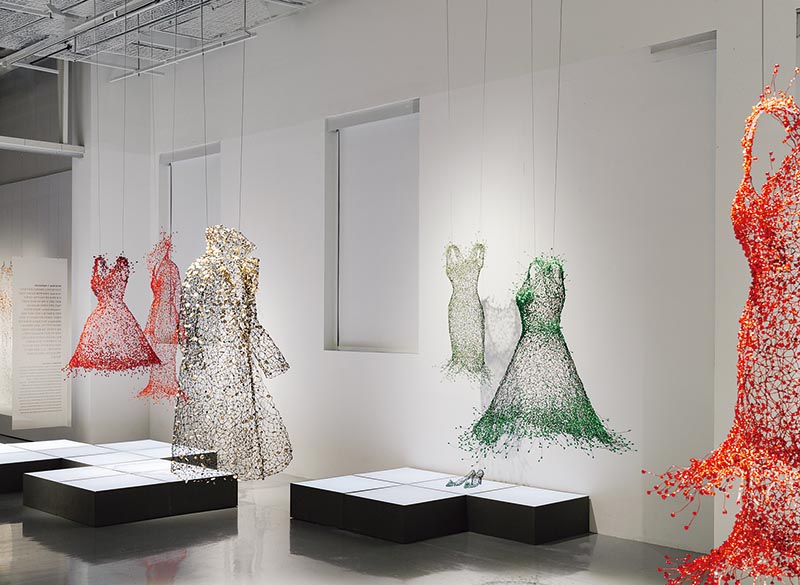
Organized by the Seoul Museum of Craft Art to commemorate a major donation of Keysook Geum’s works, the special exhibition Dancing, Dreaming, Enlightening surveys the artist’s four-decade career bridging fashion and fine art, tradition and modernity.
Courtesy of the Seoul Museum of Craft Art
Fashion art is a genre of contemporary art that uses clothing as a primary medium for artistic expression. Artist Keysook Geum is known for weaving the forms of the human body and clothing out of fine wire, as though drawing in three-dimensional space, then threading beads and scraps of fabric through the mesh to maximize the visual depth. This seamless fusion of painterly expression and sculptural form dissolves the traditional boundaries between the two-dimensional and the three-dimensional, as well as between form and space — elevating fashion art into the realm of fine art.
Among her most iconic creations is the uniform worn by placard bearers at the opening ceremony of the 2018 PyeongChang Winter Olympics. Dubbed the “Snowflake Fairy,” the design renders the voluminous silhouette of a hanbok (traditional Korean attire) skirt through woven wire mesh, into which beads, scraps of fabric, and vinyl were threaded to evoke crystallized snowflakes and ice. Complementing the gown, a floral headpiece reimagines the historic jokduri — a ceremonial coronet worn by women during the Goryeo (918–1392) and Joseon (1392–1910) dynasties. Serving as one of the costume directors for the opening and closing ceremonies of the PyeongChang Olympics, Geum meticulously handcrafted 30 costumes for the placard bearers. With each piece featuring a different design, the entire set took her over six months to complete.
“The essence of traditional Korean attire lies in its natural swaying and trembling — a harmony born from yielding to nature,” Geum explains. “I incorporated this tactile, visual sensibility into my costume design, capturing the natural movement generated by the body and the wind. This dynamic rhythm, unique to hanbok, sets it apart from the traditional dress of any other culture.” Symbolizing the vitality and energy of the Korean people, her costumes resonated with 21st-century sensibilities through distinctly Korean motifs, striking a chord with both domestic and global audiences.
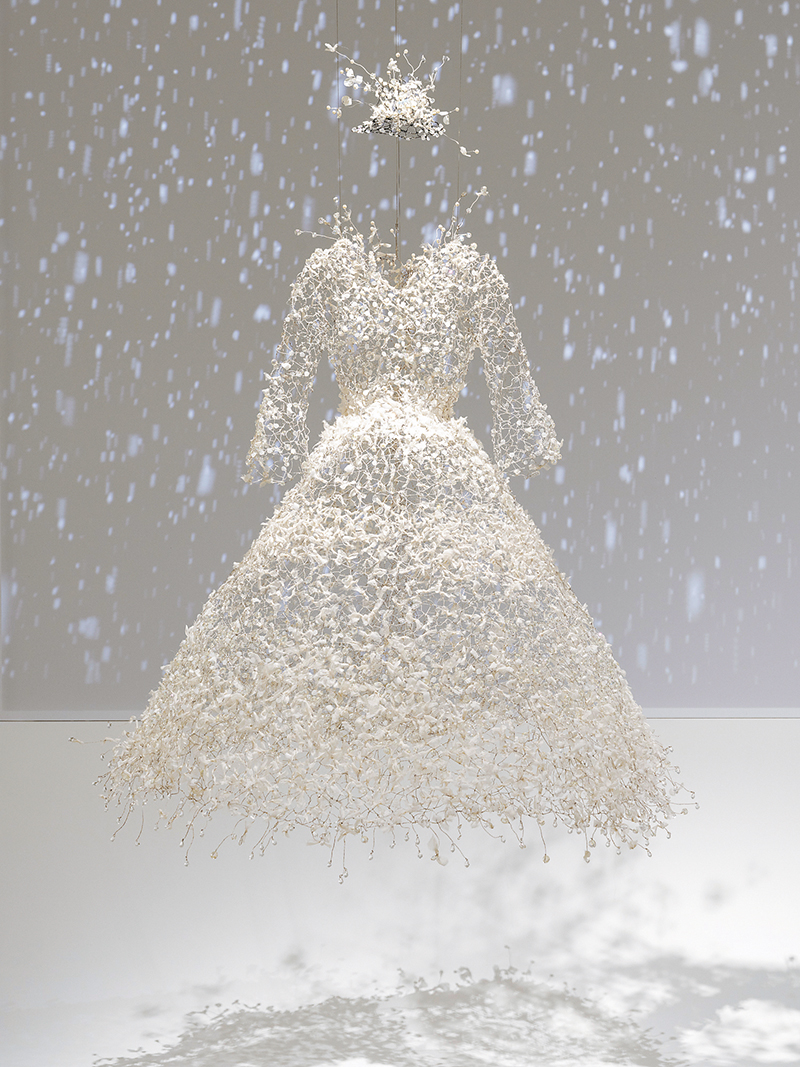
Snowflake Fairy, displayed at the special exhibition Dancing, Dreaming, Enlightening, was created for placard bearers at the 2018 PyeongChang Winter Olympics opening ceremony. This signature work brought Geum’s fashion art to international attention.
Courtesy of the Seoul Museum of Craft Art
PIONEERING FASHION ART IN KOREA
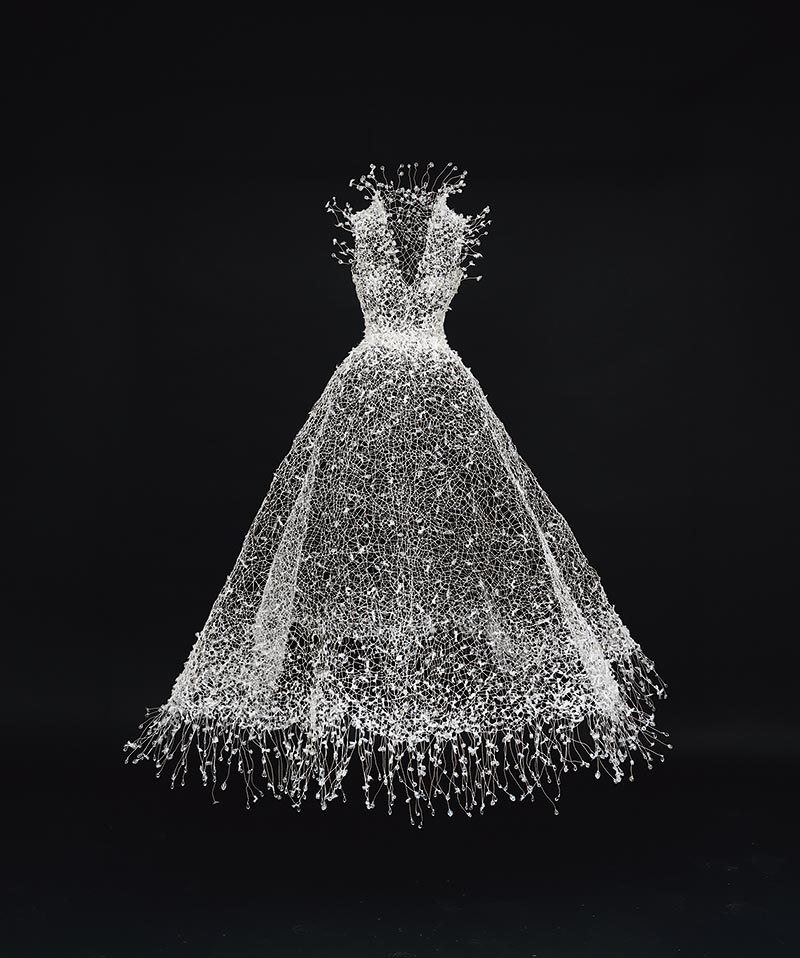
White Plum. 2024. Wire, beads, fabric.
1,500 × 1,450 mm.
Inspired by a plum tree in her garden, Geum used wire and transparent beads to evoke the vitality of plum blossoms and the passage of time.
Courtesy of the Seoul Museum of Craft Art
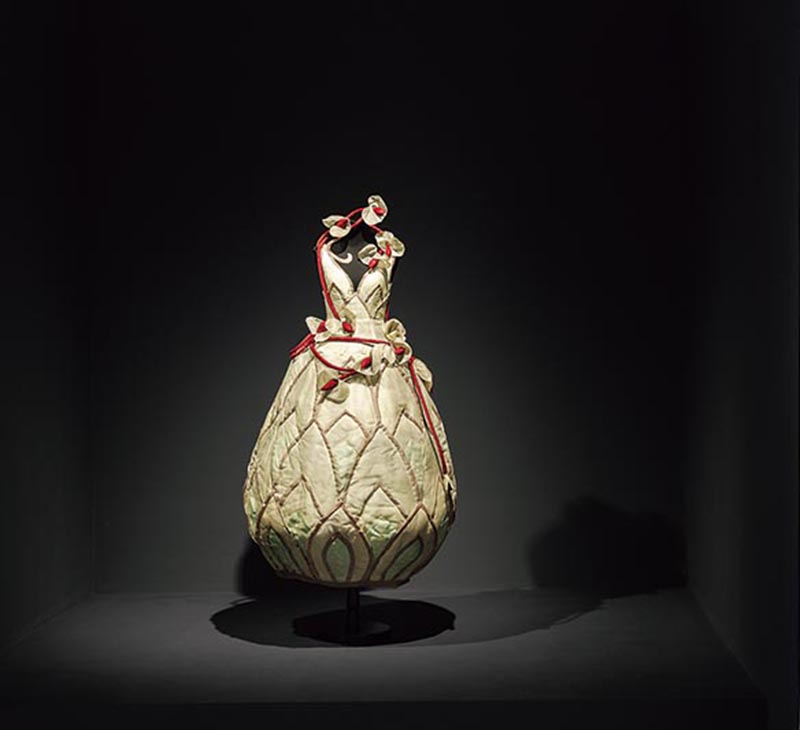
Lotus Celadon Dress. 1995. Organza.
1,350 × 800 mm.
As an early signature piece interpreting the jade hue of Goryeo celadon, the red of cinnabar, and the symbolism of lotus motifs in dress form, this work embodies Geum's experimental spirit in bridging Eastern and Western aesthetics.
Courtesy of the Seoul Museum of Craft Art
Geum majored in clothing and textiles at Ewha Womans University and married immediately following graduation, living for a time as a full-time homemaker. As her children reached elementary school age, she enrolled in graduate school to pursue a career in academia, specializing in the study of Joseon Dynasty attire. “I originally dreamed of becoming a painter,” she recalls. “I wanted to attend art school, but my parents were against it. While raising my children, I painted whenever I could and entered numerous competitions, but faced constant rejection. Concluding that I lacked the talent for painting, I decided, out of sheer perseverance, to at least pursue academia.”
Yet the creative impulse she had carried since childhood proved impossible to suppress. After earning her doctorate from her alma mater, Geum spent a year as a visiting scholar at the University of Minnesota from 1988 to 1989. During this period, the Wearable Art movement — which had emerged in the United States in the 1960s — was asserting a profound influence on the broader fashion landscape. Upon returning to Korea and joining the faculty of Hongik University’s Department of Textile Art and Fashion Design in 1991, she began translating the fluid lines, hues, and traditional motifs of hanbok into three-dimensional sculptural forms.
The true starting point of Geum’s signature fashion art style was the Lotus Celadon Dress, created in 1995 for the inaugural Gwangju Biennale’s International Art to Wear exhibition. Drawing inspiration from Goryeo celadon artifacts — such as the Celadon Gourd-Shaped Ewer with Lotus Design in Underglaze Copper — the work rendered celadon’s distinctive pale jade color, cinnabar red, and lotus motifs in the form of a dress. The piece embodies an experimental spirit that sought to bridge Eastern and Western beauty and cross the boundary between past and present. It also remains the artist’s only textile-based work. “I didn’t win any awards at the time,” she notes, “but the following year, when I saw the piece referenced at a fashion show, I gained confidence.”
Frustrated by the limitations of paper and textiles, which degrade over time and under changing environmental conditions, Geum replaced traditional thread with flexible wire used in floral arrangements. A chance encounter with a spiderweb further inspired her to integrate its intricate lattice patterns into her structural practice. Pushing her medium even further, as non-biodegradable waste emerged as a critical environmental issue, she began incorporating straws, plastic foam, and vinyl, treating them like gleaming beads to expand her material repertoire. Under her touch, garments evolved into kinetic sculptures, and discarded waste was reincarnated as fine art.
It was discerning galleries abroad that first recognized Geum’s practice. In 2003, the James Tigerman Gallery in Chicago presented the exhibition Korea-Japan Textiles, where all three of her submitted works sold within 30 minutes of opening. News traveled fast, bringing a flurry of exhibition invitations from major galleries in Minnesota, New Orleans, Tokyo, Shanghai, and beyond. Geum also expanded fashion art into a spatial element that actively shapes architectural space. In the atrium spanning decks 6 through 15 aboard the cruise ship Allure of the Seas, she installed Dream of Utopia — a massive floating work that creates an overwhelming sense of scale. She has also integrated large-scale mobile installations into the lobby of the Argo Group headquarters in Texas and the central atrium of POSCO China’s Beijing headquarters, presenting a harmonious fusion of architecture and fashion art in each setting.
A RECORD-BREAKING EXHIBITION
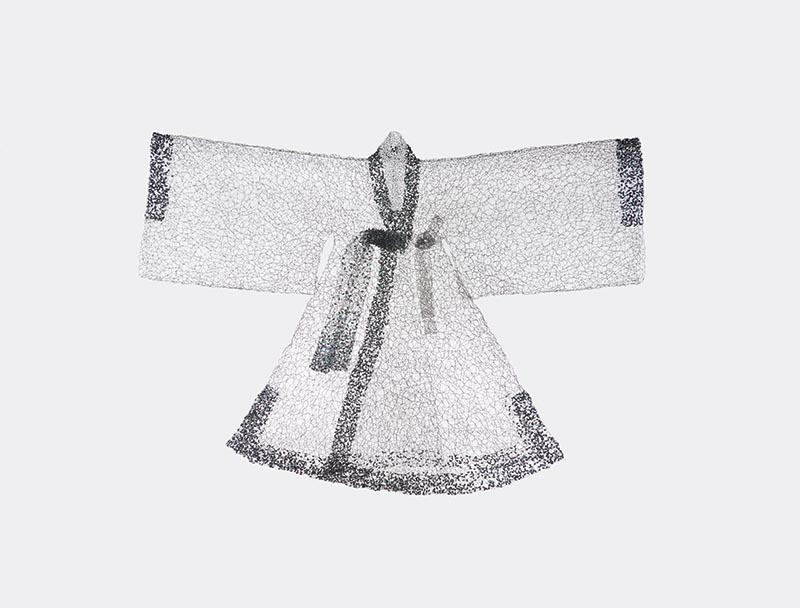
Hakchangui. 2016. Wire, beads. 1,760 × 2,400 mm.
Hakchangui was an outer robe worn by Joseon Dynasty scholar-officials as everyday attire. Through the restrained contrast of black-and-white, this faithful reproduction captures the moral character and erudition of the literati.
Courtesy of the Seoul Museum of Craft Art
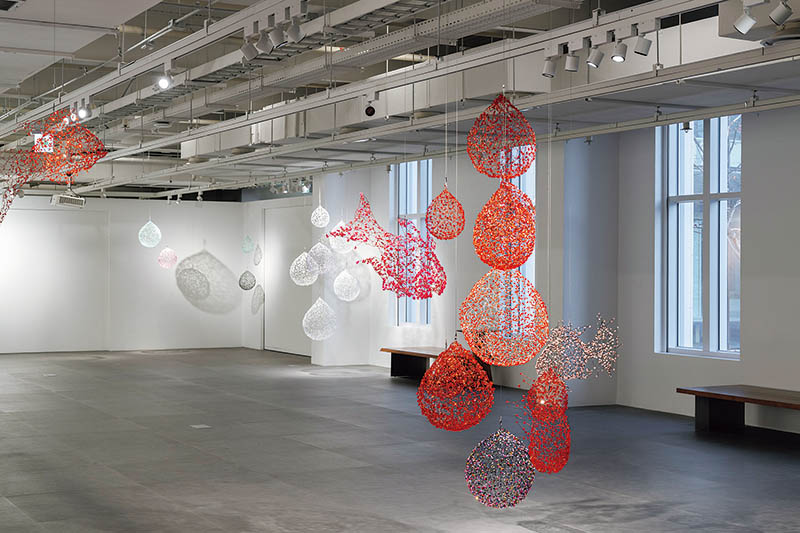
Fish and Water Drop, installed in the Seoul Museum of Craft Art's first-floor lobby, reveal the broad sculptural possibilities of Geum’s fashion art.
Courtesy of the Seoul Museum of Craft Art
Since retiring from her professorship at Hongik University’s Department of Textile Art and Fashion Design in 2018, Geum has devoted herself entirely to her creative practice. She recently made headlines by setting a new record in Korea’s exhibition history. Held at the Seoul Museum of Craft Art from December 23, 2025 through March 22, 2026, Dancing, Dreaming, Enlightening was a special exhibition highlighting Geum’s donation of 56 works and 485 archival items to the museum. The exhibition was structured to offer a comprehensive overview of her artistic universe spanning more than 40 years.
Although fashion art remains relatively unfamiliar to mainstream audiences, word of the show spread rapidly across social media, where it was hailed as a “must-see exhibition of 2026.” Visitors marveled at creations born from the fusion of familiar garment silhouettes and unexpected materials, while even those new to craft or contemporary art found the works remarkably accessible. The evocative lighting design created a dreamlike atmosphere in the galleries. With visitors forming long lines before opening each day, the museum extended the exhibition by one week. By its conclusion, cumulative attendance had surpassed 1.13 million — the highest in the Seoul Museum of Craft Art’s history and one of the largest ever recorded for a single exhibition in Korea.
In particular, two recent works displayed in darkened galleries — White Plum (2024) and the Lotus Dress (2025) — drew crowds as popular photo spots, adding to the exhibition’s popularity. Fish and Water Drop, installed in the first-floor lobby, signaled compelling new directions for fashion art’s evolution. Visitors took to social media en masse, noting how ordinary materials were transformed into extraordinary creations and marveling at their astonishing intricacy and delicacy.
ART WOVEN THROUGH PATIENCE
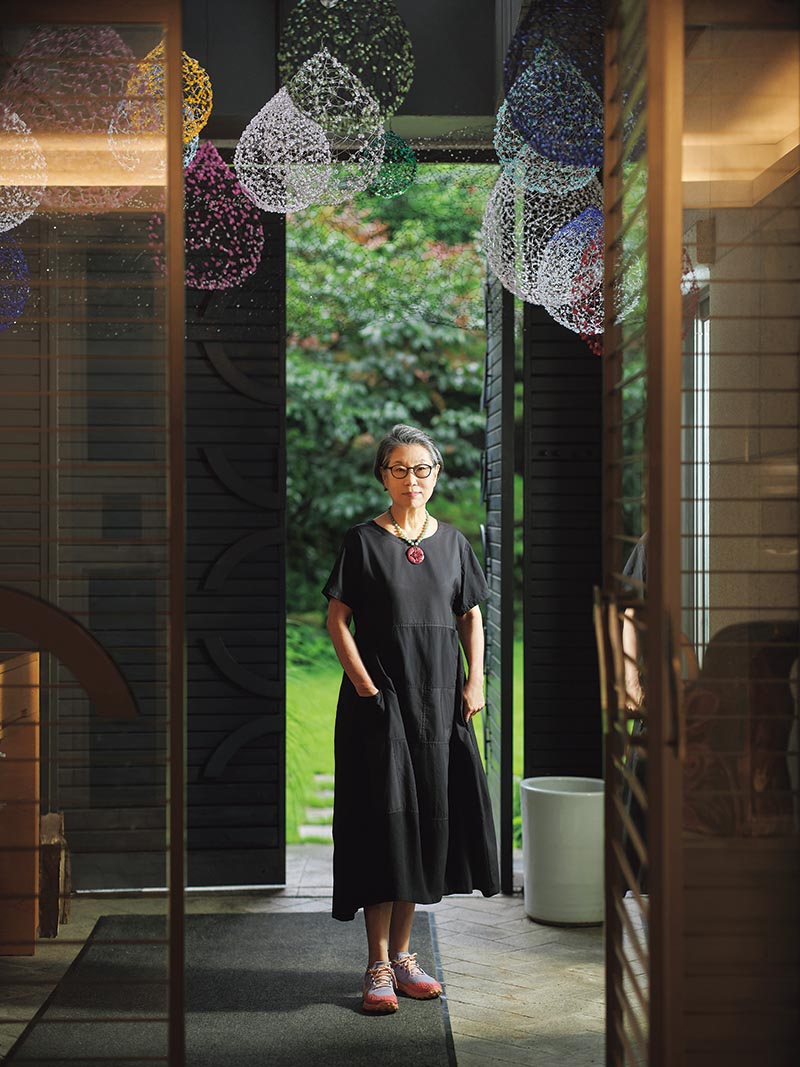
Keysook Geum stands at the entrance to the YooGeum Museum, home to her studio. Using wire, beads, and repurposed materials, she has forged a distinctive fashion-art practice spanning garments, sculpture, and large installations.
© Lee Min-hee
Keysook Geum’s studio is housed at the YooGeum Museum, renowned for its extensive collection of traditional roof tiles. Opened in 2008, the institution is co-directed by Geum and her husband. It houses approximately 5,000 East Asian roof tile ends and traditional bricks called jeondol, alongside some 2,000 Chinese earthenware figurines — all assembled through the couple’s dedicated collecting. Geum’s husband is attorney Yoo Chang-jong, nicknamed the “roof tile prosecutor.” Having collected roof tile ends as a hobby since his early days as a prosecutor, Yoo developed deep expertise in the field. In 2002, while serving as chief prosecutor of the Seoul Central District Prosecutors’ Office, he donated 1,873 roof tile ends and jeondol bricks to the National Museum of Korea — a gesture that remains the largest single-category donation of artifacts in the museum’s history. The collection earned acclaim for its exceptional historical value, encompassing Korean roof tiles and bricks from various eras alongside a systematically assembled body of Chinese, Japanese, and Southeast Asian artifacts.
Looking back on their collecting journey, Geum reflects: “Researching traditional attire naturally sparked my interest in earthenware figurines as well. My husband and I scoured antique shops both in Korea and abroad, collecting pieces one by one. Even after donating a substantial portion of the collection, quite a lot remains.”
Geum’s works often begin with memories from childhood, which may be why they resonate across such a broad range of viewers, from young children to elderly people. “When I was young, whenever persimmon blossoms fell in our yard, my mother would hand me a length of cotton thread,” she recalls. “I would gather the blossoms, string them onto the thread, and show her. She would then tie the ends together and hang it around my neck. That memory carried through into my work.” Throughout her career, she continuously pushed past boundaries. Geum’s fashion art embodies a devotion to relentless experimentation — broadening its materials, forms, and conceptual boundaries. Since debuting her fashion-art attire in the 1990 three-artist exhibition Skin at the Dongduk Art Gallery (formerly the Dongduk Museum of Art) in Seoul, she has elevated garments from mere clothing into the realm of art. Today, her practice spans garment design, sculptural art, installations, and even environmental art. For Geum, who spends nearly every day immersed in her studio practice, the most vital creation is always the next piece taking shape under her hands. Explaining her working process, she says, “Weaving and knotting each piece by hand demands a great deal of time and patience. Yet the joy of watching a creation come alive as the colors blend makes all the physical toll vanish.” As her fingertips carry on their tireless movements, the boundary between fashion and fine art continues, day by day, to dissolve.
Lee Gi-sook Writer
 한국국제교류재단