The BTS phenomenon grew out of the confluence of Korea’s unique cultural topography and the globally connected world of our era. Let’s take a look at the significance of the phenomenal success of these seven young men for the music industry and beyond.
K-pop is a music genre that emerged in the 1990s when major Korean entertainment companies began launching “manufactured” idol groups. Potential talent was recruited through auditions and trained in vocals, dance and foreign languages with the trainee period typically lasting years. Inherent in the idol-making process, where only a handful of those endowed with natural talent can achieve their dreams with hard work, is the kind of elitism and success story that dominated Korean society during the country’s rapid development phase. Even today, trainees must achieve compressed growth to survive the breakneck competition. Just as Korea’s rapid economic development served as a model for other developing countries, its idol groups are the envy of other Asian countries.
However, this Korean standard focused on rapid success entailed no small sacrifice. The sweeping pro-democracy movement of the 1980s, calls for economic democratization in the wake of the 1997 Asian financial crisis, and more recently, demands to address the widening income gap and conflict among social classes manifest the struggles of Korean society in the course of socioeconomic progress. Similarly, although K-pop has produced remarkable results, it has come at a cost, most notably, the brutality of the idol training system and the short life span of successful idol groups.
Kim Nam-joon Born September 12, 1994 in Ilsan, Gyeonggi Province; Group leader and rapper; Nicknames include “master of award acceptance speeches” and “vocal monster”; First member to join Big Hit Entertainment and especially talented in rap, songwriting and composing.
Kim Seok-jin Born December 4, 1992 in Gwacheon, Gyeonggi Province; Vocalist; Nicknames include “Madnae” (meaning the oldest member (mat hyeong), but one who behaves like the youngest (mangnae) and “Worldwide Handsome”; Talented vocalist especially noted for his emotional sensitivity.
Min Yoon-gi Born March 9, 1993 in Daegu; Rapper; Nicknames include Minstradamus (combination of surname “Min” and “Nostradamus”) and Syubgiryeok (combination of “Syub” from “Suga” and mugiryeok, meaning lacking in energy, a reference to his love for lying down and doing nothing); All-around talent as rapper, songwriter and composer.
A New Era in K-Pop
Korean society has thus sought changes in an effort to depart from the past, and with social changes it became necessary to establish a global standard that was more universal and rational. At the same time, the system that had supported the K-pop industry began to slowly crumble. That’s when BTS come on the scene.
Korea’s pop music industry, consisting of an intricate network of management agencies, broadcasting stations, the digital music market and the media, did not allow the entry of a small company like Big Hit Entertainment. Therefore, Big Hit had to go the long and hard route to launch and promote BTS. As an idol group, the seven boys adopted elements of hip hop and made active use of social media to communicate with the public. What was an inevitable choice, paradoxically, paved the way for a new era in K-pop.
One remarkable point that sets BTS apart is that whereas existing idol groups were packaged as “immaculate geniuses,” as if they were not products of the idol training system, BTS showed that the true essence of an artist lies not in talent but attitude, and that an artist is not necessarily “born” but “grows and evolves.” The group chose to highlight the incomplete over the complete, and process over results. The song “Idol” on their 2018 album, “Love Yourself: Answer,” is an honest portrayal of their struggles with their identity between idol and artist, declaring that whatever it may be, it is all part of their story of growth.
BTS’s journey from idols to artists exemplifies the angst of Korean youth. In a society that attaches great importance to credentials and results, the younger generation are gradually learning to enjoy the process regardless of the outcome. Young Koreans, who have been pressured to live a success-oriented life, have begun to dream of pursuing an “artist’s life,” that is, one where they grow and develop gradually. Their aspirations are more geared toward a global standard that goes beyond the limitations of what was distinctively Korean. Even if they “fall, get wounded, and it aches,” they seek to pursue a life of their own choice rather than do what others expect. This is actually a dream shared by youths around the world. BTS’ music sympathizes with these sentiments, which explains its far-reaching global resonance.
Kim Tae-hyung Born December 30, 1995 in Daegu; Vocalist; Nicknames include CGV (computer graphics + V) and Vwimilbyeonggi (word play on the Korean term for “secret weapon,” referring to V being the undisclosed seventh member before the group’s debut); Versatile and known for his charming s and gestures on stage.
Jung Ho-seok Born February 18, 1994 in Gwangju; Dancer and rapper; Nicknames include “Hobi,” “Sunshine” (because of his cheerful and energetic personality) and Choreography Team Leader; Arguably the best dancer in the group who shines in highly difficult sequences, also a songwriter, composer and producer.
Park Ji-min Born October 13, 1995 in Busan; Dancer and vocalist; Nicknames include Manggaetteok (for his cute face with chubby cheeks reminiscent of a rice cake, or tteok) and Dancing Bean; Entered Busan High School of Arts as a top student, well-versed in hip hop and contemporary dance styles, famous for his exquisite dance skills.
Jeon Jung-kook Born September 1, 1997 in Busan; Vocalist, dancer, sub rapper; Nicknames include Golden Mangnae (also spelled “Maknae,” meaning the youngest member) and Muscle Pig; Outstanding live vocals and flamboyant dance moves, as well as excellent photography, videography and editing skills.
The way in which these young artists interact and build rapport
with fans around the world may have greater implications for
how Korea should expand its global presence.
Shedding the Authoritarian Past
The proliferation of digital culture with the spread of the internet and social media is not irrelevant to the rise of individualism in Korean society, where familism and nationalism had long been pervasive. The traditional patriarchal social system and elitist attitudes of the development era have lost validity in the public consciousness shaped by the internet. Individuals, who were just one of the masses before, began to reveal their personal tastes and voice their opinions on digital networks.
This break from the authoritarian past has been most prominently witnessed in popular culture. What was once a vertical relationship between stars and fans became increasingly mutual and interactive. The public no longer viewed celebrities simply as s of adoration, but as individuals they could relate to; in some cases, fans even offered advice on an artist’s career direction. This new type of fandom that emerged in the 1990s could have been a foreshadowing of the relationship between BTS and their fandom, ARMY (Adorable Representative M.C. for Youth).
BTS’ fandom is different from those of other idol groups in that the social media space where they interact is a global stage, its worldwide reach transcending language and nationality. ARMY is an outgrowth of the digital democratization, which effected huge changes in Korean society over the past few decades, and the global expansion of the strong public consciousness that it gave rise to.
Korea’s geopolitical situation has demanded it seek opportunities overseas tonew growth engines. During the development phase, resources were imported from abroad, processed and the end products exported. But the Korean standard that pushed the country to achieve compressed growth in a short period of time lost force long ago. In today’s globalized world, with its ever-increasing digital interconnectedness, the existing standard no longer promises prosperity. At this juncture, BTS has presented the possibility for a much-needed jumpstart.
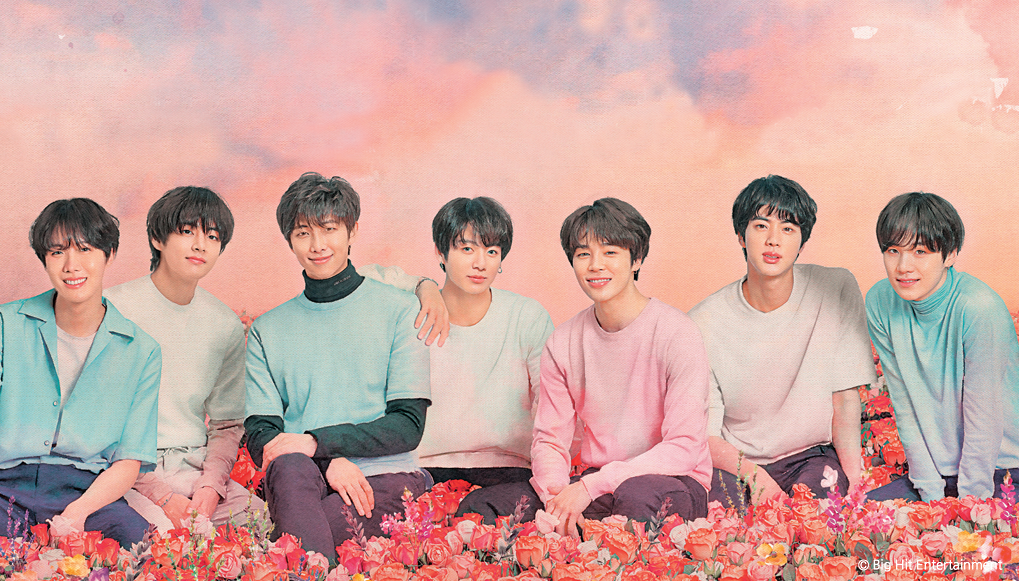
Poster image for the 2018 world tour “Love Yourself,” which covered the United States, Canada, United Kingdom, the Netherlands, Germany, France and Japan. From left: J-Hope, V, RM, Jungkook, Jimin, Jin and Suga.
Expanding Global Presence
The global nature of their fandom means that BTS have to pursue universality in forging an emotional bond with their fans. The way in which these young artists interact and build rapport with their fans around the world may have important implications for how Korea should expand its global presence.
The whole country is elated about BTS’s rise to global stardom not just because it is unprecedented for Korean artists, but because it also suggests Korean society is breaking away from a past bound by national sentiment and confined by regional ties to move further out into the world.
 한국국제교류재단