Award-winning broadcast writer Oh Kyung-ah left her career to learn how to design gardens. The move was her way to live a healthy and happy life. Now she plants gardens in tightly-packed urban areas, feeling fulfillment at the peace of mind her colorful oases give visitors.
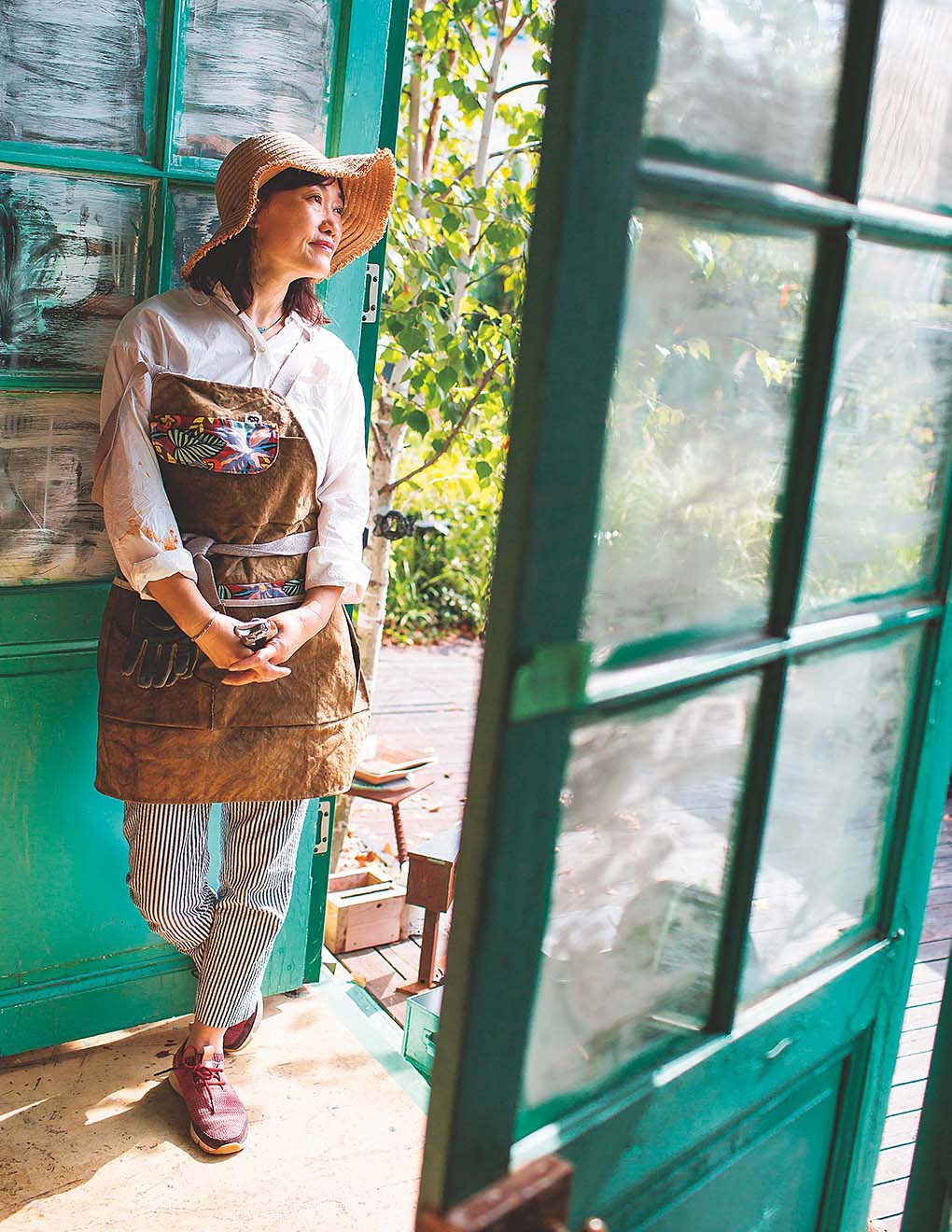
Oh Kyung-ah looks out from her garden design institute, an annex of her home in Sokcho, Gangwon Province.
“I have only been away for a month but everything’s in a muddle. I’d better get busy.”
Having spent a month away from home, visiting her daughter who works in Kenya, the first thing garden designer Oh Kyung-ah does when she returns is ready herself to work on her garden. The garden surrounding her home in Sokcho, a port city on the east coast in Gangwon Province, covers around 660 square meters and contains more than 100 different species of plants. She can easily recite both their Korean and Latin names.
Oh has turned an annex of her home into the “Oh Kyung-ah Garden Design Institute.” This is where she teaches garden design and horticulture. When she is not promoting her horticulture passion, Oh designs large-scale, high-profile projects. They have included the “Seed Bank Garden” for the Suncheon Bay International Garden Expo in 2013, and more recently a rooftop garden for a massive shopping mall in Bucheon, Gyeonggi Province.
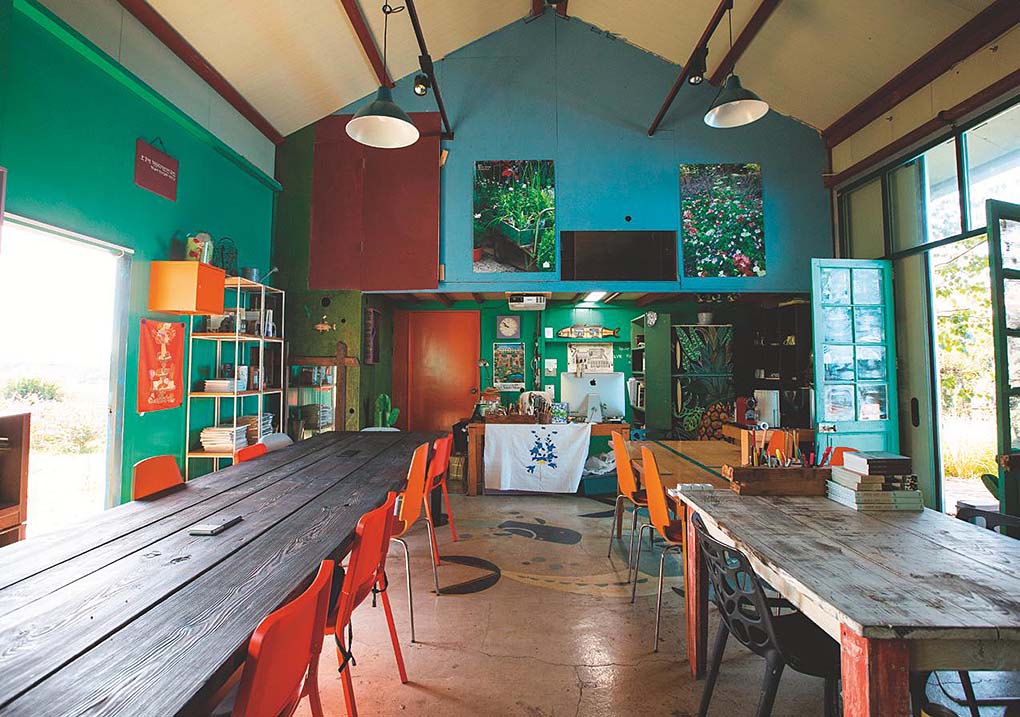
In the annex, Oh conducts occasional classes on horticulture and garden design.
Pursuing Health and Happiness
Lim Hee-yun: So, you used to be a writer for the radio?
Oh Kyung-ah: I majored in French language and literature at university and started work in broadcasting as soon as I graduated. Excluding maternity leaves, I worked without a break from 1989 to 2005.
Lim: I see that in 2003 you were awarded the “This Year’s Writer” prize at the MBC Entertainment Awards. What made you suddenly turn to designing gardens at the peak of your career?
Oh: I was preparing up to 10 A4 pages of broadcast script each and every day. Over time, my emotional capacity and creativity really were exhausted. My body wasn’t coping either. I got sick more and more often, with sinusitis and constant coughing. And then, one day I was driving over the Mapo Bridge and I saw the sky above Yeouido all darkened with smog. At that moment I wished I could do work that would allow me to be healthier and happier until my old age.
Lim: And that led to working with gardens?
Oh: Yes. I grew up in a house with a yard. Different flowers would bloom every season and there was a climbing rose that grew up a wall. After I got married, I began to really get into gardening. As soon as I returned home from work, I’d throw my bag down in the living room and go straight out into the garden. My husband told me, “You know what? When you’re doing broadcasting work, you’re all prickly and on edge, but when you’re in the garden yourand the way you speak become calm and comfortable.” That’s when I thought I should pursue a second career in something connected with gardens. I was just absent-mindedly browsing online when I came across garden designing. I started putting together my application for a program in England right away. I was 38 at the time.
Lim: It can’t have been an easy decision. What was it like when you got there?
Oh: The subject suited me perfectly well, but it was incredibly hard to keep up with everything. My husband stayed behind in Korea and I had my two daughters with me who had just finished elementary school. My English was still clumsy, so it was a massive stress just trying to open a bank account, but having to send my kids to school and take care of their needs on top of everything else meant that every day was a stream of touch-and-go episodes. As soon as I opened my eyes in the morning, I’d be worrying about what could go wrong that day.
Lim: What was it like studying garden design?
Oh: I didn’t know enough about plants, so moving on to design was impossible. In consultation with my supervisor, I decided to do a one-year internship. So I joined the team at Kew Gardens in London, the oldest modern botani - cal gardens in the world, as an intern gardener. To this day, that one year is still my greatest asset. They don’t just grow plants there for show, they grow many different species for research purposes, too. I volunteered my way through a broad range of departments, working with everything from tropical plants in hot houses to herbaceous plants outdoors. During that time, I was able to experience all the different things that you can only learn by doing them yourself, from watering to preventing insect damage and pruning.
Lim: Is there much difference between a garden designer and a gardener or landscaper?
Oh: Garden designers have a totally different role alto - gether. It’s a garden designer’s job to design all of the space apart from the building, which is the responsibility of the architect. From planning out the exact number of shrubs and plants, to contrasts between the colors of plants and the tex - ture of leaves, the garden designer designs a space so that the materials of the building and the properties of the plants harmonize beautifully. When necessary, the garden design - er may even request specially made pots or sculptures to go with the garden, giving potters and artists a specific design brief. You can think of a garden designer as someone who works to bring together the whole look and feel of a dwelling and its surroundings.
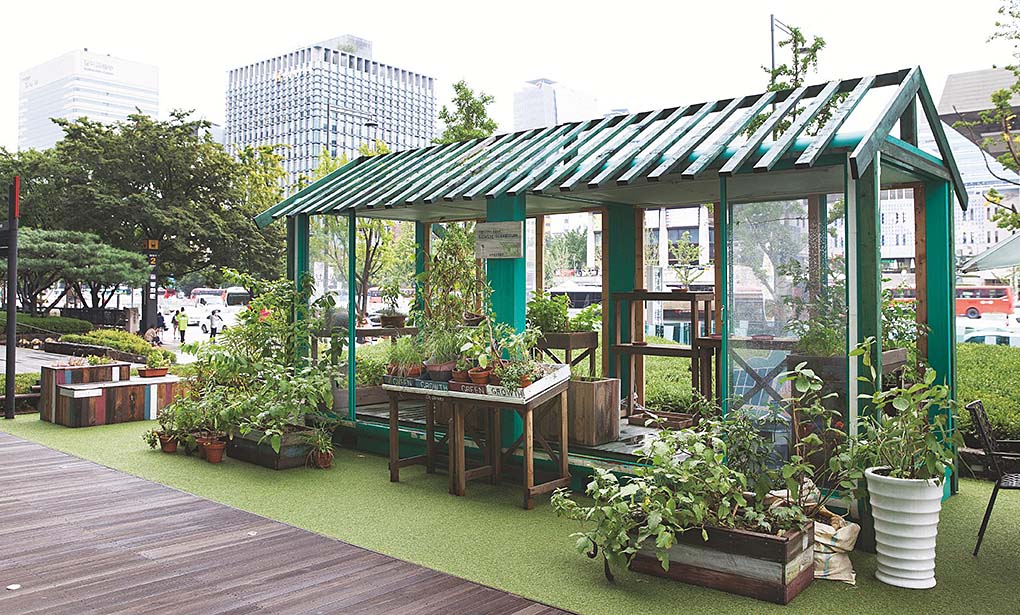
Oh Kyung-ah created this garden by repurposing a container discarded in central Seoul to provide citizens with a place to relax from the fast pace of a bustling metropolis.
“It’s not that there aren’t any bees or butterflies in the city, it’s just that the way we live in cities means that we never come face to face with them.”
Getaways of Calm
Lim: These days you are also giving talks. What are listeners most eager to learn?
Oh: I get lots of questions about how to care for plants so that they don’t die. But plants die for many reasons, even if the person tending them does nothing wrong. You see, first and foremost, plants being grown in the city have been taken out of their natural habitat. That means any given plant can’t complete the average lifespan cited in an encyclopedia. People who want to grow plants at home I would encourage to just go ahead and give it a try without worrying that they might die. After all, plants are very reasonably priced in Korea.
Lim: But such a large proportion of the population lives in cities, and in high-rise apartments at that. Isn’t it a bit of an extravagance to grow plants in such an environment?
Oh: Not at all. Plants are absolutely necessary for our mental well-being. Judging by the comments people leave online these days, most people are extremely on edge emotionally. Mental health professionals around the world are strongly recommending people do more gardening. They say that watching new shoots sprout from the soil produces a healing hormone inside the body, the same kind of hormone that’s released when a parent sees their child taking their first steps. A few years ago, the British Medical Association even made gardening something that could be officially prescribed to various kinds of patients by their doctors. For some conditions, working in a garden two times a week, two hours a day, can be more effective than taking multiple doses of painkillers or tranquilizers.
Lim: You have recently been working on a rooftop garden for a mall in Gyeonggi Province. It seems as though roof gardens are becoming much more common these days.
Oh: The shopping mall has only just opened, so there are still construction materials around everywhere, but as soon as we planted a few plants, there were butterflies and bees flying around as though they had been waiting in hiding. It’s not that there aren’t any bees or butterflies in the city, it’s just that the way we live in cities means that we never come face to face with them. Recently, more and more commercial spaces are trying to attract customers by installing gardens. But the areas in most dire need of gardens are the most densely built-up parts of big cities, with high concentrations of tall buildings. Even if it’s only in the small, leftover spaces, bringing nature into the city is vital for everyone’s well-being.
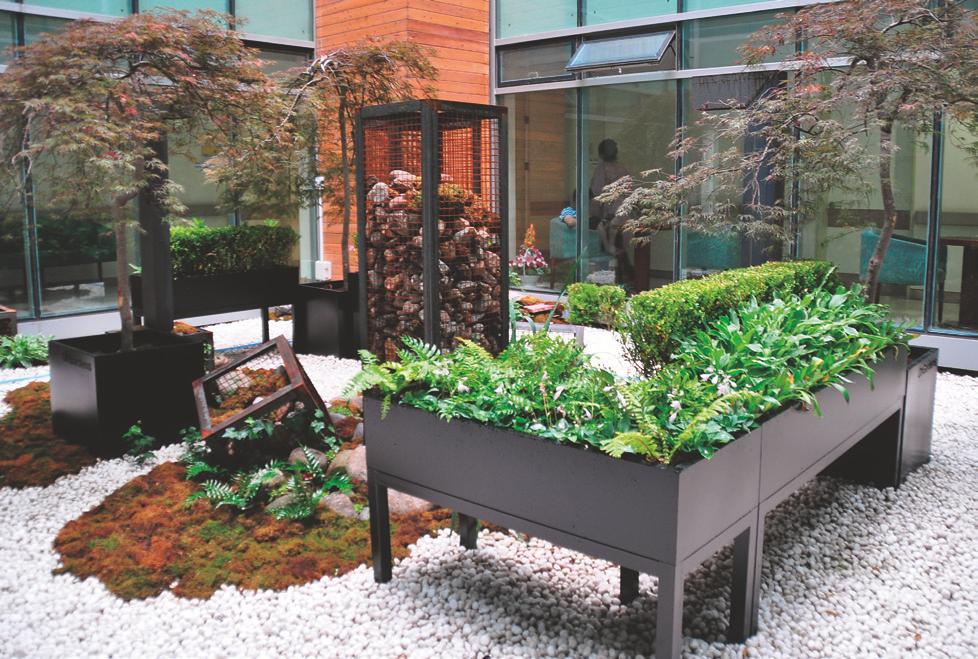
A courtyard garden at the Joongang OB & GYN Clinic in Sokcho. The space does not get any sunlight, so plants such as ferns, mosses and flowering hostas were carefully selected for the design.
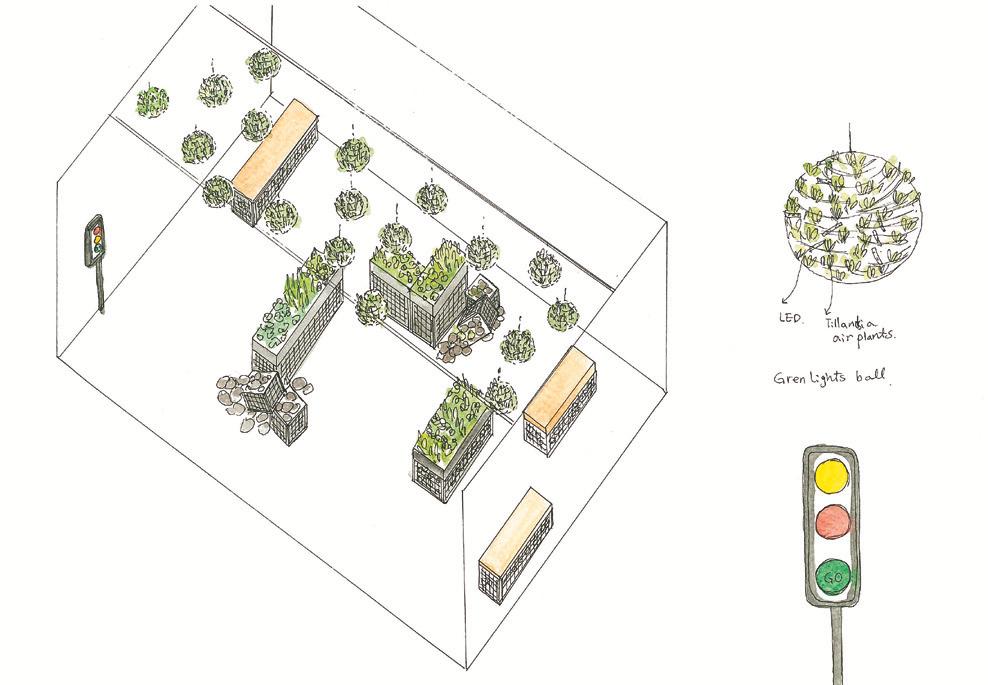
A sketch for the Art Garden Rest Spot, which was entered into the 2014 Seoul Living Design Fair with the support of Hana Financial Group
Joyful Plans
Lim: Are there any particular gardens in Korea that you would recommend for people to visit?
Oh: There are so many. Among some of the best, there is the Garden of Morning Calm in Gapyeong, the Jade Garden in Chuncheon, the Seomi Garden in Namhae and the Oedo Botania in Geoje. Particularly interesting is the Seomi Garden, an English-style garden made up mainly of herbaceous plants, which is a real rarity in Korea, so I go there quite often.
Lim: Do you have any particular plans for the future?
Oh: I’d like to spend more of my time in Sokcho and be in my garden more. And I also want to devote more time into putting the finishing touches to “The Shed,” the garden café I opened earlier this year. I also want to write books aimed at young readers. I’d like to create a series that combines children’s stories with basic knowledge about gardens. When it comes to gardening, the earlier you start learning about it the better.
Lim Hee-yun Culture Reporter, The Dong-A Ilbo
Ha Ji-kwonPhotographer
 한국국제교류재단